Author
Monica Cid
Mónica Cid is a Product Marketing Engineer at NXP, helping developers innovate with the FRDM ecosystem, MCX microcontrollers, and edge computing technologies.

Explore how the FRDM ecosystem equips developers to build and scale AI/ML applications at the edge. From MCU-based smart sensing and TinyML to Linux-powered edge AI, FRDM combines scalable hardware, eIQ® software tools, GoPoint demos and Application Code Hub (ACH) resources to accelerate development from concept to deployment.
AI and ML are rapidly moving closer to where data is created. Across industrial, consumer and IoT designs, more intelligence is shifting from the cloud to the edge so devices can sense, decide and respond in real time. Lower latency, stronger privacy, better energy efficiency and reduced dependence on always-on connectivity are driving this move. Recent industry analysis also points to a growing architectural split —model training that often stays in the cloud while inference increasingly moves onto embedded and edge devices.
For developers, this opportunity also introduces complexity. One project may begin with smart sensing, anomaly detection or motion recognition on a microcontroller (MCU), while the next may require keyword spotting, image classification, object detection or voice-enabled user interfaces on a Linux-based processor. The challenge is not only choosing the right hardware but also finding a development platform that helps teams start quickly, evaluate real use cases and scale to more advanced AI workloads without restarting the journey each time requirements grow.
Explore FRDM hardware, AI tools and resources. Learn more here.
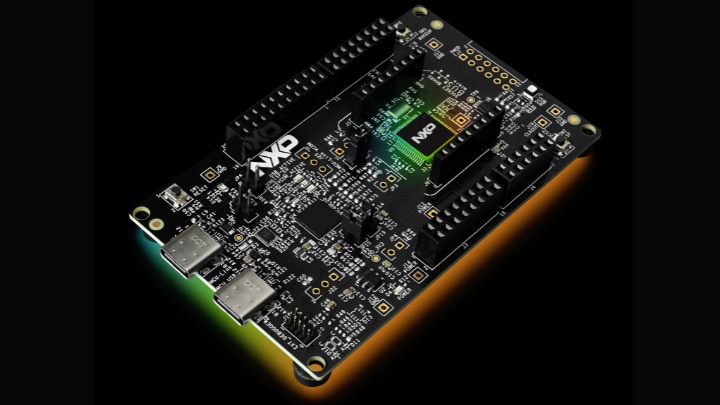
The FRDM development platform solution manages the complexity emerging from edge AI/ML workloads. NXP’s FRDM ecosystem is designed as a family of low-cost, compact development boards spanning both MCUs and applications processors, supported by modular hardware, software tools and solution-driven application examples. FRDM is more than a board family—it is an ecosystem designed to simplify prototyping, accelerate development and help engineers move more efficiently from concept to real embedded intelligence.
One of the most valuable benefits of the FRDM platform is that developers can choose a starting point based on the actual AI workload they need today, while keeping a migration path to more capable devices tomorrow. The FRDM portfolio spans from MCU-based boards for smart sensing and TinyML-style exploration to Linux-based microprocessor (MPU) platforms with integrated AI acceleration for advanced vision, audio and edge computing workloads.
At the entry level, FRDM MCX A156 provides a practical foundation for smart sensing and embedded control applications. Built around the MCXA156 based on Arm® Cortex®-M33, the board supports use cases such as connected control, smart sensing and industrial human machine interface (HMI), with features including 16-bit analog-to-digital converter (ADC), controller area network-flexible data rate (CAN-FD), FlexIO, USB and flexible sensor and peripheral expansion. For developers beginning with lighter AI-adjacent workloads, such as intelligent sensing, data monitoring or simple embedded pattern recognition, this class offers an accessible,low-cost starting point.
For developers ready to move into more capable AI inference directly on an MCU, the FRDM MCX N947 adds a major step forward. The board is based on the MCX N947, which integrates dual Arm Cortex-M33 cores and on-chip accelerators including a neural processing unit (NPU), PowerQuad and SmartDMA. It also supports camera, audio and display expansion, making it well suited for real-time use cases such as anomaly detection, low-resolution vision, object classification and audio intelligence at the edge.
When applications require Linux®, richer multimedia or more demanding AI models, the FRDM portfolio extends into application processors. FRDM i.MX93 is NXP’s first FRDM development platform built around an i.MX Application Processor and provides a low-cost entry point to Inux-based edge AI. It includes the i.MX 93 applications processor with dual Arm Cortex-A55 cores, an Arm Cortex-M33 core and an Arm Ethos-U65 micro-NPU, along with Mobile Industry Processor Interface Camera Serial Interface (MIPI-CSI) camera input, display interfaces and connectivity. This makes it a strong platform for smart HMI, entry vision AI, edge gateways and industrial IoT applications that need both application processing and ML acceleration.
For higher-performance multimedia and vision workloads, the FRDM i.MX 8MPLUS offers a strong balance of AI capability, connectivity and system integration. The board is based on the i.MX 8M Plus applications processor and combines quad Arm Cortex-A53 cores, an Arm Cortex-M7, a HiFi4 digital signal processor (DSP) and an integrated NPU, along with dual MIPI-CSI camera interfaces, HDMI, low-voltage differential signaling (LVDS), audio and broad connectivity support.
At the high end of the FRDM family, FRDM i.MX 95 is designed for next-generation edge systems that need advanced AI acceleration, rich multimedia and industrial-grade connectivity. The board is based on the i.MX 95 applications processor and integrates a heterogeneous compute architecture with Arm Cortex-A55, Arm Cortex-M7, Cortex-M33 and the NXP eIQNeutron NPU, along with camera and display interfaces, dual Ethernet and expansion capability. FRDM-IMX95 includes an M.2 Key-M slot for AI cards, opening a path to even more capable accelerated AI configurations.
A central part of the FRDM story is that it enables practical edge AI, not just evaluation hardware. Running AI inference directly on the device can reduce latency, improve privacy, lower bandwidth requirements and keep applications functional when cloud connectivity is limited or unavailable. These benefits are especially important for time-sensitive sensing, industrial monitoring, vision pipelines and voice or HMI experiences that need responsive, deterministic behavior.
Hardware acceleration is a key part of making on-device AI practical. On platforms such as FRDM MCX N947, the integrated NPU is designed to offload the heavy mathematical operations used in neural network inference, improving efficiency versus CPU-only execution. On Linux-based platforms such as FRDM i.MX 93, FRDM i.MX 8MPLUS and FRDM i.MX 95, integrated AI acceleration helps developers evaluate more advanced workloads such as object detection, segmentation, speech-related processing and intelligent video or HMI functions directly on embedded hardware.
Explore FRDM hardware, AI tools and resources.
Making AI/ML development accessible requires more than the right processor. Developers also need a software workflow that connects model creation, optimization and deployment, reducing time spent on integration work. eIQ AI software development environment provides the software foundation for AI/ML development across NXP MCUs and MPUs. This streamlined system-level AI application development includes workflow tools, inference engines, neural network compilers and optimized libraries to.
For neural-network-based applications, the eIQ Toolkit supports end-to-end model development and deployment. Developers can bring their own data or models, import models from TensorFlow, PyTorch or Open Neural Network Exchange (ONNX)-related flows, optimize models and export them into runtime-ready software pipelines for NXP targets.
For sensor-centric workloads, eIQ Time Series Studio (TSS) adds another important capability—end-to-end edge AI development tool for time-series data TSS supports workflows such as data curation, model generation, optimization, emulation and deployment. It also supports anomaly detection, classification and regression.
Together, these tools enhance the value of FRDM: for developers, allowing them to choose a board and select a workflow that can support data collection, model preparation, optimization, deployment and on-device inference across different levels of edge AI complexity. This is especially beneficial for engineering teams that need to move from idea to proof of concept quickly, then refine and optimize for their specific target application.
For Linux-based FRDM platforms, GoPoint for i.MX Applications Processors adds an important layer of out-of-box enablement, an intuitive interface that gives developers easy access to application-specific demos for i.MX processors, helping them quickly evaluate platform capabilities and understand how specific use cases map to the underlying hardware.
GoPoint is included in NXP’s i.MX Linux support flow and is updated as part of the board support package (BSP)release process, reinforcing its role as a fast-start development experience rather than a one-off demo package. This is highly relevant for AI/ML development because GoPoint lets developers quickly discover and run prebuilt demos without manually assembling the full software stack or building a complete application from scratch.
While GoPoint is ideal for quickly exploring capabilities on Linux-based i.MX platforms, the ACH provides the reusable implementation layer that helps developers expand across the NXP portfolio. The ACH is a centralized repository for software examples, code snippets, application software packs and demos developed by NXP experts and partners, with search and filtering options that help engineers quickly find examples by product family, category and application use case. It is also accessible through MCUXpresso integrated development environment (IDE) and MCUXpresso for Visual Studio (VS) Code, enabling direct project import for compatible applications.
What makes the ACH a valuable development resource for AI/ML is how projects are searchable by category, such as AI/ML, vision, voice or anomaly detection. This allows developers to study, run and customize working projects in their environment. Rather than treating AI demos as isolated marketing examples, ACH provides a path toward reusable, source-available implementation assets that can be adapted into real product development workflows.
What makes eIQ, GoPoint and ACH a particularly powerful combination is what each brings to the table:
Another key advantage of the FRDM ecosystem is its broader development path for edge AI systems. Developers can start with MCU-based platforms for low-power sensing and embedded ML, move to MPU-based boards for Linux, multimedia and richer AI pipelines, then extend performance further AS application demands grow.
For designs that require even more AI compute, NXP also provides an expansion path through accelerators such as the Ara240. The Ara240 being connected to FRDM i.MX 95 and FRDM i.MX8 MPLUS through the board’s M.2 Key-M slot, along with runtime software development kit (SDK) enablement, helps developers verify module detection and begin working with the accelerated AI environment. This provides a compelling bridge from scalable FRDM prototyping to higher-performance edge AI implementation within the broader NXP ecosystem.
Whether the application begins with smart sensing, predictive maintenance, voice interaction, image classification, object detection or more advanced edge AI, developers need a platform that streamlines the journey. FRDM closes the gap by combining scalable MCU and MPU hardware, integrated software tools, optimized AI workflows and developer enablement resources that reduce friction from evaluation through implementation.
What makes FRDM a strong platform for AI/ML development is how it helps make intelligent embedded systems possible, accessible and scalable. Imagine a development journey starting with the hardware level that matches today’s application, using eIQ to build and deploy models, exploring capabilities quickly with GoPoint, and moving into customization and reuse through ACH, all within one connected ecosystem. For engineering teams looking to bring more intelligence to embedded products, FRDM provides a practical and flexible path to build smarter systems at the edge.
Additional Resources:
Product Marketer at NXP Semiconductors
Mónica Cid is a Product Marketing Engineer at NXP, helping developers innovate with the FRDM ecosystem, MCX microcontrollers, and edge computing technologies.