As artificial intelligence drives unprecedented compute density into data centers, rack power consumption is increasing from traditional levels of 5-15 kW to more than 100 kW in modern AI deployments.
Next-generation AI chips are expected to draw 1 MW per rack and beyond, a significant increase compared to today's almost 200 kW1. At these power levels, conventional air-cooling approaches are reaching their practical limits, accelerating the transition to liquid-cooled infrastructure and making precise sensing and control more critical than ever.
At the center of the cooling infrastructure is the coolant distribution unit (CDU). A CDU delivers coolant at the required temperature and flow rate while isolating the facility water loop from the technology cooling loop. As liquid cooling capabilities become more sophisticated, the CDU is also emerging as the system's central point for sensing, diagnostics and real-time control.
Liquid Cooling Shifts the Challenge to Instrumentation
Moving coolant is only one part of the CDU's role. Reliable operation depends on continuous visibility into conditions throughout the cooling system.
A modern CDU may need to monitor:
- Coolant pressure
- Inlet and outlet temperature
- Flow rate
- Reservoir or fluid level
- Leak conditions
- Coolant quality
These measurements support alarms, thermal stability, system protection and serviceability. They also provide the data required to detect deteriorating performance before it results in equipment downtime. In this environment, sensing accuracy and diagnostic coverage become just as important to reliable operation as pumps, valves and heat exchangers.
The challenge for CDU manufacturers is that these measurements can involve many different sensor interfaces. One design may need voltage or current inputs, while another may use resistance-based sensors, resistance temperature detectors (RTDs), thermistors, thermocouples or industrial 4 mA to 20 mA transmitters for pressure, flow, level and coolant quality monitoring. Supporting each interface with separate analog circuitry increases board area, component count, calibration effort and development time.
A configurable analog front end (AFE) offers an alternative. Instead of designing a dedicated signal chain for every sensor, manufacturers can use a common hardware platform and configure individual channels to support the required measurements.
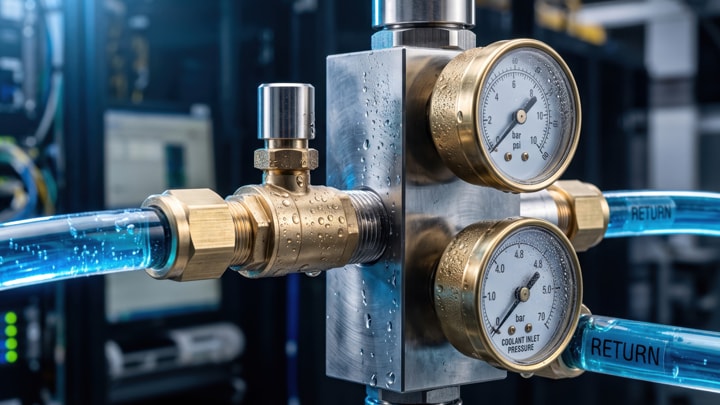 Configurable AFEs simplify the connection within CDU sensors, such as pressure, flow and temperature.
The Role of NXP Analog Front End (NAFE) in a CDU Architecture
The NXP's NAFE devices are designed to operate between the CDU's sensors and its main microcontroller or system controller. In this architecture, pressure, temperature, flow, level and leak sensors connect to the NAFE front end. The device configures the applicable input type, measures the sensor signal, performs calibration and monitors diagnostic conditions. It then passes the measurement data to the controller.
The controller uses that data to execute cooling algorithms, manage telemetry, generate alerts and command actuators. These actuators may include variable-frequency drives for pumps, control valves, bypass mechanisms and industrial current loops.
This separation creates a clear signal path as outlined in the graphic below:
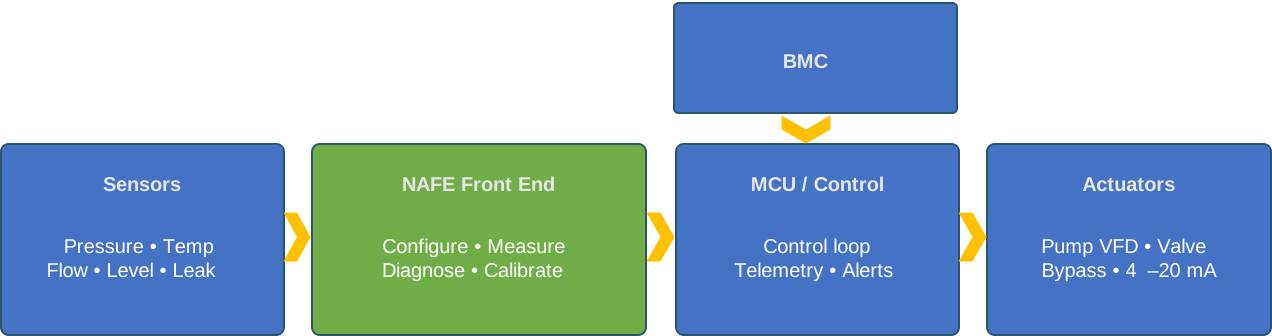 NAFE devices connect CDU sensors to the MCU, enabling configurable measurement, calibration and diagnostics for closed-loop monitoring and actuator control.
For a better experience, download the block diagram.
By consolidating analog measurement functions into a configurable device, CDU designers can reduce the number of specialized circuits on the controller board. The same platform can also be adapted to different sensor combinations through software configuration, reducing the need for extensive hardware redesign.
Universal Inputs Simplify the Sensing Architecture
A central advantage of the NAFE portfolio is its support for universal analog inputs. Depending on the selected device, the same front end can interface with voltage, current, resistance, RTD, thermistor, thermocouple, differential and single-ended sensor signals.
This flexibility gives CDU manufacturers several design benefits:
- Reduces the number of unique analog circuits and components required on the board
- Allows manufacturers to support multiple CDU models using a common controller design
- Simplifies changes when a customer specifies a different sensor or measurement range
Software-selectable inputs can also reduce the number of product variants a manufacturer must maintain. A common board may be configured for rack-level, row-level or facility-level CDU designs, improving platform reuse and reducing engineering effort across the product family.
Diagnostics Support Higher CDU Availability
Data-center operators rely on the continuous operation of cooling infrastructure. A sensor failure, damaged cable, incorrect connection or drifting measurement can compromise thermal performance even when the mechanical cooling components continue to operate.
NAFE devices address this requirement with integrated diagnostic capabilities. Depending on the selected device, these capabilities can include open-circuit and short-circuit detection, anomaly monitoring, internal temperature measurement, calibration paths and interface-integrity checks.
Such diagnostic capabilities allow a CDU to distinguish between an actual process condition and an instrumentation fault. For example, the system may be able to identify whether an unusual pressure reading represents a cooling-loop problem or a disconnected sensor.
Build smarter liquid-cooling systems. Explore NXP's NAFE portfolio for precise sensing, diagnostics and control solutions.
Diagnostic data can also contribute to predictive-maintenance workflows. Instead of waiting for an instrument to fail completely, operators can identify abnormal behavior, schedule service and replace affected components during planned maintenance windows, if necessary.
Pump health monitoring can further improve CDU uptime because the pump is one of the most critical components in a liquid-cooling system with its performance directly affects the ability to maintain thermal stability across AI racks. By monitoring pressure, flow, temperature and related sensor signals, the CDU can track pump operating trends and detect abnormal conditions before they result in pump or system failures. This allows operators to move from reactive maintenance toward predictive maintenance, supporting cooling-system availability and protection of the high-value computing infrastructure.
Rugged Analog I/O for Industrial Environments
Although CDUs serve advanced computing environments, their sensing and control electronics face many familiar industrial challenges. These include electromagnetic interference, wiring errors, elevated or changing temperatures, high input voltages and limited controller-board space.
The NAFE portfolio is designed to support these industrial operating conditions. Features across the family include wide industrial temperature support, high-voltage input capability, electromagnetic compatibility (EMC) and miswiring protection and compact packaging for space-constrained controller designs.
This combination helps reduce the amount of external protection and conditioning circuitry needed around the AFE. It can also support more robust systems when sensors are remotely mounted or connected through long cables.
Extending the Architecture from Sensing to Control
Some CDU applications require more than accurate measurement. They also need precise analog outputs to control pumps, valves, actuators and industrial interfaces.
The NAFE33352 addresses this requirement by combining sensing with voltage and current output capabilities. It includes an analog input/output channel, two universal input channels, an 18-bit digital-to-analog converter (DAC) and a 24-bit analog-to-digital converter (ADC). It supports output ranges of up to ±12.5 V or ±25 mA, along with output protection, diagnostics and readback.
This integrated functionality can support closed-loop control strategies in which the CDU measures a process condition, calculates the required response, drives an actuator and verifies the resulting output. Potential applications include valve-position control, pump control and 4 mA to 20 mA industrial loops.
Bringing sensing and actuation into a coordinated analog platform can reduce external circuitry while improving control-loop visibility.
Matching NAFE Products to CDU Requirements
NXP's portfolio provides tailored options for monitoring-focused designs, closed-loop control and broader universal platforms.
NAFEB43388: Compact for CDU Monitoring
The NAFEB43388 is positioned as a sensor hub for compact eight-channel CDU monitoring designs. It can accommodate measurements such as pressure, flow, temperature, fluid level and leak detection.
The device combines a 24-bit ADC with ±25 V input capability and factory calibration. Its power consumption of approximately 55 mW and 6 mm × 6 mm package make it suitable for space-constrained monitoring designs.
NAFE33352: Integrated for Sensing and Control
The NAFE33352 is intended for CDU designs that require closed-loop actuation. Its combination of universal inputs and analog output capability supports applications in which the controller must both monitor operating conditions while commanding pumps or valves.
Output diagnostics and protection provide additional visibility into the actuation path, helping designers create more reliable voltage- and current-controlled systems.
NAFE13388: A Scalable Universal Platform
The NAFE13388 is aimed at a broader, sensor-flexible industrial data-acquisition applications. The family includes four- and eight-channel options, as well as 24-bit and 16-bit ADC choices. Integrated excitation and calibration sources simplify connections to a wide variety of sensors. This flexibility makes the device a strong candidate for manufacturers building a reusable controller platform that must serve multiple CDU configurations or customer requirements.
From Lower Complexity to Differentiated Control
A configurable analog architecture can deliver benefits across the CDU product lifecycle. Replacing multiple discrete sensor front ends with universal, software-selectable inputs reduces analog complexity to simplify board design. Integrated diagnostics improve fault detection, support predictive-maintenance strategies and enable health monitoring of critical assets, such as pumps, valves, filters and sensors.
A common controller board can be reused across rack, row and facility CDU variants, accelerating platform development while reducing the number of designs that must be qualified and maintained. The addition of integrated voltage and current outputs also creates opportunities for more sophisticated control. Manufacturers can develop differentiated pump and valve strategies while maintaining a compact system architecture.
Building a More Intelligent Cooling Platform
The transition to liquid-cooled AI infrastructure increases the importance of instrumentation inside the CDU. Accurate sensing, continuous diagnostics, flexible interfaces and dependable actuator control are becoming central to effective CDU operation rather than optional additions.
NXP's NAFE portfolio addresses these needs through configurable analog inputs, high-resolution conversion, integrated calibration and diagnostics, rugged industrial interfaces and—in selected devices—analog control outputs.
For CDU manufacturers, this approach offers a path toward smaller and more reusable controller designs. For data-center operators, it supports better visibility, earlier fault detection and more precise thermal control. Together, these capabilities can help transform the CDU from a mechanical distribution system into an intelligent, adaptable control point for next-generation liquid-cooled data centers.
Ready to explore NAFE solutions for CDU design? Discover the NAFE portfolio that enables flexible sensing, diagnostics and control in data center cooling.
1ABB's new direct current portfolio article aims to rewire AI data center energy infrastructure | Markets Insider: Sep 21, 2026