If cameras, LiDAR and IMUs are a robot’s eyes and inner ear, then precision analog measurement is its “sense of
self”, the quiet awareness of currents, strains and temperatures that tell you how the machine is really doing.
Among the components that enable this awareness, the NAFEB43388 stands out as a robust,
multichannel analog front end
(AFE) with eight configurable inputs up to ±25 V, a 24‑bit delta‑sigma ADC, a built‑in PGA, excitation sources for
resistive sensors, and rock‑solid EMC and miswiring protection, all-purpose built for industrial‑grade accuracy and
resilience.
It isn’t a camera, it isn’t LiDAR, and it won’t run Simultaneous Localization and Mapping (SLAM). But if your
Autonomous Mobile Robot (AMR) or humanoid needs to measure force, strain, current, or temperature with high
fidelity, while shrugging off electrical abuse, the NAFEB43388 becomes a surprisingly strategic
building block.
The Device at a Glance and Why It Matters
- 8 analog inputs (singleended or differential), configurable for voltage, current, resistance, RTDs and
thermocouples
- ±25 V input range, up to ±36 V overvoltage protection
- 24bit ΔΣ ADC, PGA (×1 to ×64), integrated voltage/current excitation, lowdrift reference
- Data rates: 7.5 SPS → 288 kSPS with 17bit ENOB at ~72 kSPS; SPI interface
- EMChardened inputs, diagnostics, CRC, wide temp range (−40 °C to +125 °C) in a 6 mm x 6 mm 40pin HVQFN
In short, it’s an industrial DAQ front end, miniaturized for embedded systems. Perfect for the quiet, continuous
measurements that help robots last longer, carry smarter and move safer.
Design smarter sensing at the edge. Build more reliable robotics and industrial systems with
the NAFEB43388.
Autonomous Mobile Robots: Accuracy Where It Pays
The ForkLift AMR That Never Overloads
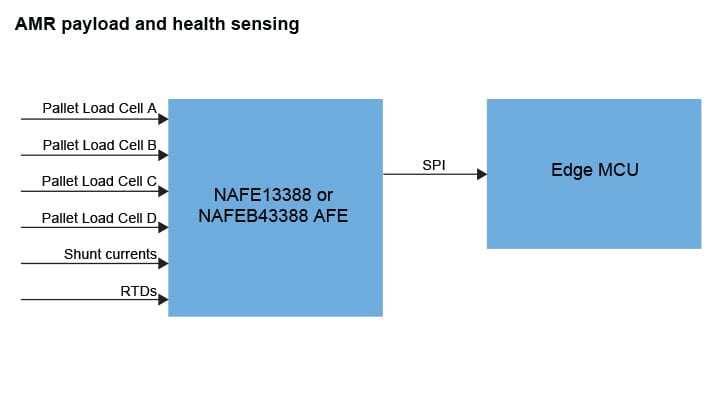
Scene: A warehouse AMR pulls under a pallet. Its lift rises. Before moving, it checks four load cells embedded around
its lift carriage.
Enter NAFEB43388: Load cells and strain gauges are bridge sensors; they demand low noise, stable excitation and
careful gain. The NAFEB43388 supplies precision excitation, applies programmable gain and digitizes at
24bit
resolution; allowing you to resolve small changes in load (think “box #17 was stacked a little offcenter”). Those
eight channels can cover multipoint sensing across a platform or mast, giving both total payload and load
distribution for balance and safety.
Payoff: Fewer tipped pallets. Smarter route and speed profiles that consider actual mass, not a guess.
Fork-lift AMR verifying payload before transport, load-cell sensing turns lift force
into actionable safety data.
Early Warnings: Bearings, Brakes and Battery Health
Scene: The AMR has been humming along for months. A cloud dashboard flags a trend: slightly rising motor phase
currents at the same speed/load, correlated with a subtle temperature rise near a wheel gearbox.
Enter NAFEB43388: The device multiplexes precision readings such as shuntbased current, RTDs, thermocouples and bus
voltages so you can fuse electrical and thermal signals into a single health score. With 17bit ENOB at 72 kSPS, it
collects data fast enough for diagnostics while maintaining the DC accuracy needed for driftfree trending. Robust
input protection ensures reliable operation even in the presence of noisy industrial EMI.
Payoff: Planned downtime replaces surprise breakdowns; conditionbased maintenance becomes real.
Harsh Floors, Unkind Cables
Factories and depots aren’t kind to wires: miswires, hotswap mishaps and surges happen. The NAFEB43388’s ±36 V
overvoltage tolerance, ESD and surge robustness give you a margin of survival that typical AFE and MCU ADC pins
don’t. The result is fewer failures and less fingerpointing between mechanical, electrical and firmware teams.
Humanoids: Feeling the World, Not Just Seeing It
Feet That Read the Ground
Scene: A humanoid stands on uneven grating. Its cameras and IMU know where it is; but balance demands knowing how
weight flows through each foot.
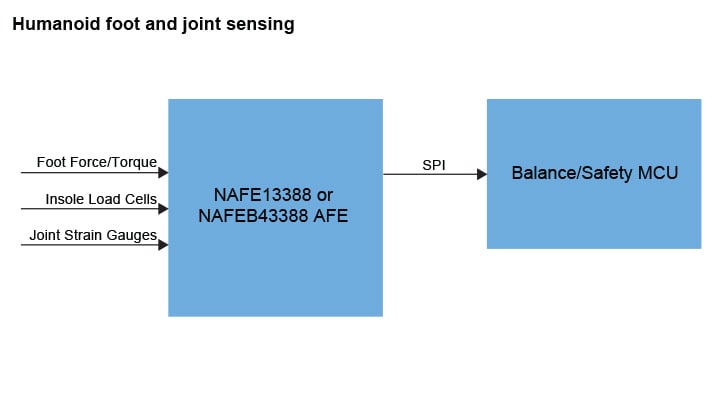
Enter NAFEB43388: Multiaxis foot forcetorque sensors and distributed load cells benefit from synchronized, lownoise
measurement. With careful channel configuration and shared excitation, the NAFEB43388 delivers subtle loadshift
detection, which is critical for zero moment point (ZMP) control and push recovery. Accuracy often matters more than
highkilohertz rates in this domain, and deltasigma latency is acceptable for control loops in the 100 to 500 Hz
range.
Humanoid foot-force sensing uses distributed load measurements to support balance
control and early fault detection.
Torques You Can Trust but Know the Limits
Scene: A joint uses a Series Elastic Actuator (SEA) with a strain element. You want precise torque for impedance
control.
Fit: The NAFEB43388’s 24bit ADC, PGA and excitation are tailormade for strain gauges. But keep it off the inner motor
current loop (5–20 kHz): the ΔΣ conversion latency isn’t designed for that job. Pair it with your motor driver’s
fast SAR ADCs or integrated shunt sense for current control and let the NAFEB43388 inform outer impedance and safety
loops.
The Silent Watchers: Heat, Voltage and Structural Strain
Humanoids are powerdense. Embedding RTDs in motor endbells, thermocouples on inverters and strain foils in
loadbearing members gives early warnings before delamination or insulation breakdown. The NAFEB43388’s calibration
sources and diagnostics help turn those whispers into actionable telemetry, without littering the design with analog
helper boards.
Quick Sketches: Where It Sits in the Stack
Block Diagram of AMR Payload and Health Sensing.
Block Diagram of Humanoid Foot and Joint Sensing.
Where Not to Use It and What to Use Instead
- SLAM and perception using LiDAR, cameras, radar and IMUs are digital, high-bandwidth domains where the AFE adds
no value
- Inner motor current loops should use motor drivers with fast ADCs, often SAR, plus isolated shunt amplifiers,
and keep ΔΣ AFEs for outer loops and diagnostics
- Large tactile skins with hundreds to thousands of taxels require array-optimized ICs or matrix-scanning
solutions rather than an eight-channel precision AFE
These limitations stem from the NAFEB43388’s conversion model and channel count, strengths for accuracy but not for
throughputheavy tasks.
Design Notes: Getting the Best Out of NAFEB43388
Choose the Right Data Rate
FFor force, torque and RTD sensing in control loops, an effective bandwidth of 500 Hz or less is typical. The
NAFEB43388
supports a wide range of data rate settings from 7.5 SPS to 288 kSPS, allowing you to select exactly what your
filters
and control loops require while balancing latency and ENOB.
Exploit the Integrated Excitation
Bridge sensors require stable excitation. Using the AFEs built in sources reduces BOM, saves PCB area, minimizes
gain
and offset drift compared to ad hoc drivers, and simplifies field calibration through the device’s internal
references.
Budget for SPI Bandwidth
Eight channels at high rates add up. Plan SPI clock, DMA and buffering on your MCU; use time aligned sampling for
multi
point force readouts to avoid aliasing in balance or payload estimation.
Think Survivability First
One hallmark of this device is robust front end protection (ESD, surge, miswires). Route high voltage analog pins
with
creepage/clearance in mind and keep noisy power stages physically isolated. This is how you preserve datasheet level
accuracy in real plants and warehouses.
Evaluate Fast
NXP provides the NAFEB43388 EVK Arduino shield evaluation board and example firmware to explore
voltage/current/RTD/thermocouple modes quickly, reducing bring up friction for robotics teams that don’t live in
analog
schematics every day.
A Tale of Two Robots - Mini Case Studies
The “Weight Smart” AMR
A logistics AMR was experiencing mysterious wheel slip errors. Engineers instrumented the lift deck with four load
cells
into a NAFEB43388, enabling real time payload mass and center of mass estimates. The navigation stack began speed
limiting and turn rate capping based on actual mass and center of gravity offset. Result: 40% fewer slip
interventions
and less tire wear in a month. The AFEs ±25 V range and EMC robustness handled the electrically hostile forklift
bay
without redesigns.
The Humanoid with Surer Footing
A biped research platform was unstable during toe off on grated floors. By adding distributed load cells in the
forefoot
and routing them through the NAFEB43388 with synchronized reads, the controller detected minute lateral load shifts
and
adapted ankle impedance mid stance. The ΔΣ latency was acceptable at 200 Hz, and the internal calibration references
helped maintain accuracy across thermal swings near onboard power electronics.
Quick Comparison: Is an AFE excessive for your design?
| Need |
NAFEB43388 Fit |
Why |
| Payload/loadcell precision |
Excellent |
Bridge sensors + excitation + 24bit accuracy |
| Battery and thermal diagnostics |
Excellent |
Mixed voltage/RTD/thermocouple support |
| Foot force and balance (humanoids) |
Great |
High ENOB; synchronized multipoint sensing |
| Inner motor current loop |
Poor |
ΔΣ latency; use SAR/driver ADCs |
| Vision/SLAM sensors |
Not applicable |
Digital, highthroughput domain |
| Ultralowcost bots |
Excessive |
MCU ADCs may suffice |
The Quiet Specialist: Precision Sensing That Keeps Robots Honest
The NAFEB43388
is not the hero of your navigation stack, but it is the quiet specialist that keeps your robot honest,
safe and durable. In AMRs, it supports payload accuracy and condition based maintenance. In humanoids, it enables
force
and torque awareness, balance and health monitoring, provided it is not placed inside the kilohertz rate motor
loops.
Use it where accuracy, robustness and configurability matter. Pair it with the right driver electronics and control
architecture, and your robot will not only see better but also feel and understand itself more completely.