



S32T Automotive Touch Solution

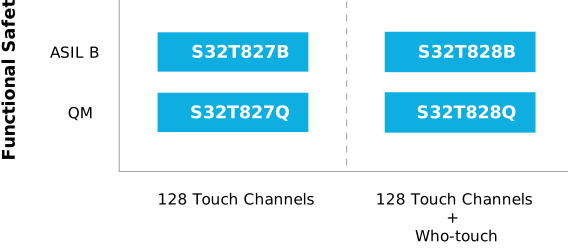
The S32T family of automotive touch solutions brings intelligent, safety-focused and high-performance touch sensing to next-generation vehicle cockpits. Designed for software-defined vehicles (SDVs), S32T combines advanced touch processing, innovative Who-touch user identification and integrated safety and security features to enable intuitive, reliable and personalized human-machine interfaces (HMIs) across displays, smart surfaces and digital cockpit systems.

This scalable solution enables OEMs and Tier 1 suppliers to deliver immersive user experiences while addressing the growing demand for functional safety, display performance and system integration in modern vehicles.

S32

FAQ's

What are the challenges with large automotive touch displays?

Challenges for large automotive touch displays include the risk of driver distraction, unintended inputs and reliability issues in demanding automotive environments. Additional challenges stem from the requirement to operate accurately despite electromagnetic interference, display-induced noise, temperature variation and space constraints from ultra-thin display designs.

What does “context-aware touch” mean?

Context-aware touch refers to sensing technologies that can interpret not only where and how a user touches a display, but also the context of the interaction. For example, the system may distinguish whether an input comes from the driver or the passenger, enabling smarter and safer control behavior.

Why is user differentiation important in shared cockpit displays?

User differentiation is important with shared cockpit displays because user differentiation enables the vehicle to distinguish the origin of an interaction, such as whether the driver or passenger initiated a touch input. This is especially important in dual-view or shared-display environments, where the system may need to prevent unintended actions or restrict certain controls to the appropriate user.

How does functional safety apply to touch-based vehicle controls?

Functional safety applies to touch-based vehicle controls by helping the system detect faults, communicate reliably and transition to or maintain a defined safe state. As more vehicle controls move from mechanical components to digital surfaces, functional safety support helps address the risks associated with hardware or software faults. Certain S32T products are designed to support automotive systems targeting requirements up to Automotive Safety Integrity Level B (ASIL B) under ISO 26262.

How do advanced sensing architectures improve touch performance?

Advanced sensing architectures improve performance by increasing signal-to-noise ratio techniques, adaptive frequency management and low-voltage drive schemes. These approaches help maintain accurate, responsive touch detection across changing environmental conditions and display configurations.

How are automotive touch systems validated?

Automotive touch systems are validated through testing under real-world operating and environmental stressors. Validation includes testing across temperature extremes, electromagnetic disturbances and user variability to assess robust performance and support compliance with automotive quality standards.

What should be the main features of a vehicle’s HMIs?

Important features for the next generation of automotive HMIs include context-aware functionality such as responsive touch sensing, occupant differentiation, functional safety support, noise immunity and reliable operation across demanding display environments. Combining reliable sensing, user-aware interaction, and Important features for safety-driven system design, solutions can help enable cockpit experiences that are more intuitive, flexible and dependable.