Autonomous vehicles have long promised to transform transportation. But moving from experimental systems to scalable, real-world deployment has proven far more complex than early visions suggested. Today, that gap is beginning to close as software-defined vehicle (SDV) architectures enable vehicles that can evolve continuously, adapt across applications and unlock new capabilities through software, not hardware redesigns.
At the center of this shift is Applied EV. The company's mission is to enable what it calls physical AI: intelligent, fully autonomous machines designed for commercial and industrial work environments. With its Digital Backbone architecture and more than a decade of SDV development, Applied EV is pioneering platforms that centralize intelligence, reduce hardware complexity and deliver safety-rated autonomy at scale.
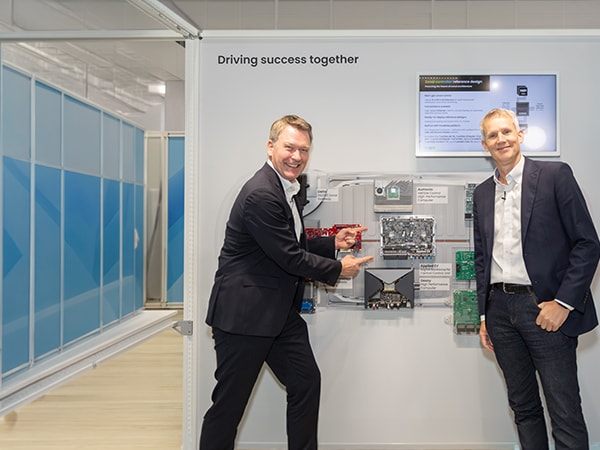
Through a long-standing collaboration, NXP and Applied EV have brought this vision into production. By combining Applied EV's system architecture and software stack with NXP's broad automotive-grade silicon portfolio and deep domain expertise, the two companies are demonstrating how software-driven mobility can move beyond prototypes and into real world, fleet ready deployments.
While the automotive industry has made major advances in electrification and driver assistance, many vehicle platforms remain constrained by legacy architectures. Traditional designs rely on distributed electronic control units (ECUs), each handling a specific function, adding hardware complexity, increasing wiring and integration effort, and driving up long-term maintenance costs.
These architectures slow innovation in critical ways. New capabilities often require dedicated hardware, along with lengthy integration and validation cycles, making iterative software updates costly and time consuming. Because functionality is tightly coupled to individual ECUs, scaling or reconfiguring vehicles for new applications becomes difficult, especially in commercial and industrial environments.
As autonomy levels increase, these limitations become even more pronounced. Advanced autonomous operation demands tightly synchronized processing across perception, motion control, diagnostics, safety and actuation layers. Fragmented systems struggle to deliver the required performance, reliability and safety certification efficiently.
For Applied EV, the challenge and opportunity was to replace this complexity with a centralized, software-defined approach that enables vehicles to evolve continuously through software, not repeated hardware redesigns.
Applied EV's answer to the challenge of traditional architectures is the Digital Backbone, a fully software-defined, safety-rated central control system that consolidates all vehicle motion control into one architecture. The platform replaces the patchwork of ECUs with a unified compute system, enabling OEMs to build vehicles where intelligence is centralized, scalable, and easily updated.
The Digital Backbone serves as the "brain" of the vehicle. It processes sensing, localization, drive-by-wire systems, power management and actuation layers through a single safety-certified controller. Unlike traditional ADAS systems designed from passenger-vehicle baselines, Applied EV built its architecture from the ground up for Level-4 autonomous operations, particularly for commercial and industrial deployments where repeatability and operational uptime are paramount.
Powered by the Digital Backbone, the Blanc Robot is a compact utility vehicle developed in partnership with Suzuki Motor Corporation. Now, in its 6th generation, the Blanc Robot is suitable for various autonomous use-cases, from city-based first and last-mile deliveries to cargo dispatch on industrial sites.
Centralized, safety-rated vehicle control and networking.
Safety-critical control for body, steering, traction and I/O.
Application-level compute, HMI and AI-adjacent workloads.
NXP plays a central role in enabling Applied EV's architecture. Across the Digital Backbone and the Blanc Robot platform, Applied EV integrates more than 100 NXP devices, forming the foundation of its electronics ecosystem. The NXP S32G and S32K SoCs in the Blanc Robot Generation 6 serve as the foundation for critical vehicle safety, motion control and management systems, while NXP's i.MX application processor is utilized for the development of customer in-vehicle experiences.
The companies' multi-year collaboration has enabled deep integration, both technically and within customer engagements. NXP provides the silicon foundation and engineering expertise; Applied EV brings the architecture, software stack and real-world deployment models that put those technologies into action.
Applied EV's progress marks a significant inflection point for software-defined mobility. What began as advanced architecture development has moved rapidly into commercial readiness and real-world deployment.
The company is actively rolling out Level 4 autonomous vehicles with customers, with initial deployments beginning as early as Q3 2026. These vehicles operate without cabins and perform repeatable commercial and industrial tasks, demonstrating that centralized SDV architectures can meet the performance, safety and reliability demands of production environments.
By pairing a production ready control architecture with an OEM validated vehicle platform in the Blanc Robot, Applied EV has created a faster path to autonomous vehicle development. This approach reduces hardware and integration complexity, enables continuous software innovation and lowers overall development cost and engineering effort.
As interest grows, Applied EV is seeing a pipeline of customers looking to bring these capabilities into their own fleets and applications. The Digital Backbone, combined with Blanc Robot or other OEM platforms, offers a practical way to adopt SDV principles without redesigning vehicle architectures from the ground up.
The collaboration between NXP and Applied EV continues to grow, rooted in shared priorities such as delivering safe, secure, software-defined systems, accelerating OEM adoption through proven architectures and scaling SDV benefits across commercial, industrial and passenger markets.
The shift to software-defined mobility is no longer conceptual—it is becoming operational. NXP and Applied EV are helping lead that transformation with architectures designed around centralized intelligence, functional safety and operational durability. Through the Digital Backbone, the Blanc Robot and a decade of SDV expertise, Applied EV is proving what Level-4 autonomous vehicles can achieve in real commercial environments.
Applied EV was founded with the mission of "bringing innovation to transportation." The company's Digital Backbone™ is a vehicle electrical architecture platform that enables SDVs (Software-Defined Vehicles). Building on this core technology, the company developed the innovative Blanc Robot™ platform, with Suzuki Motor Corporation as a manufacturing partner, designed for a wide range of applications. In December 2025, JAPAN POST CAPITAL invested in Applied EV to support its expansion into last-mile logistics.
Learn more about Applied EV标签: 汽车电子, Step Forward
Marketing Communications Manager at NXP
Monica Davis leads Automotive Marketing Communications at NXP Semiconductors. With a focus on software-defined vehicles and next-generation automotive platforms, she connects technology trends to the challenges and opportunities facing the mobility industry.