Designers have less time than ever to move products from concept to production. At the same time, consumers now
expect network connectivity in nearly every device they buy. Meeting these expectations within increasingly
compressed development cycles requires engineers to choose and validate their wireless connectivity solution early
in the design process, before committing to a board layout.
In this blog, you will learn how our latest connectivity solution makes it easier for designers to evaluate Wi-Fi,
Bluetooth® Low Energy (LE), and 802.15.4 on NXP hardware, even when they are not radio frequency (RF) experts.
This enables teams to bring smarter, connected devices to market faster, without the associated risk and legwork.
Introducing the IW610G-M2 Development Card
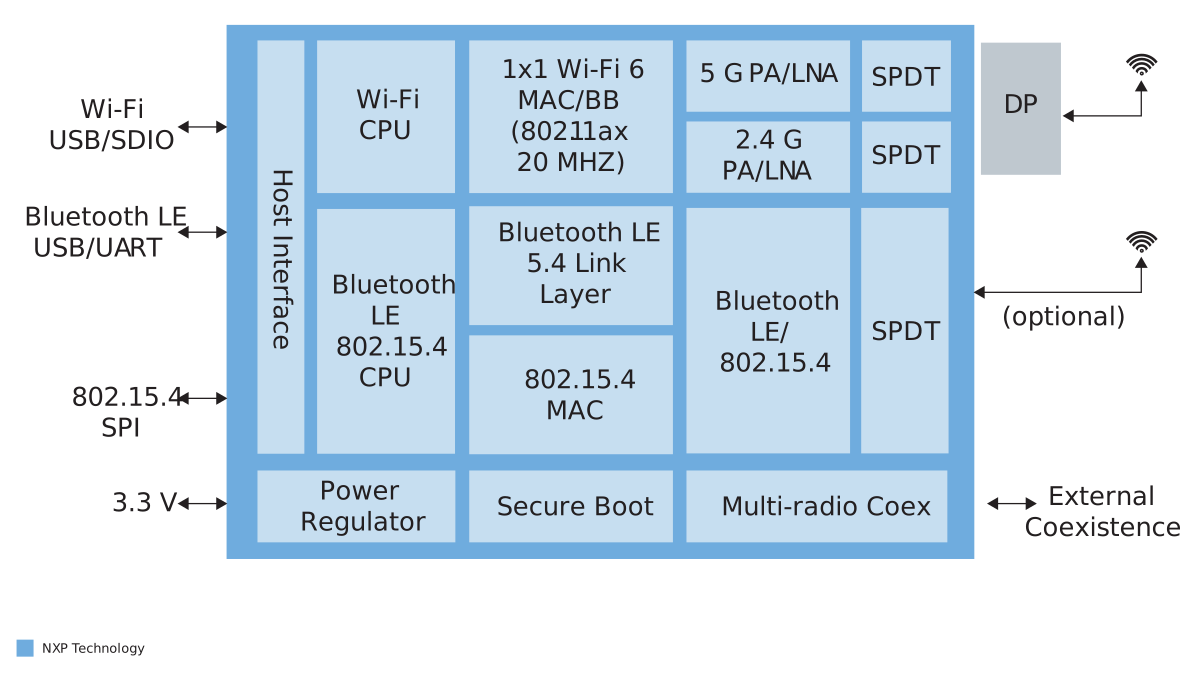
NXP is introducing the IW610G-M2 development card that enables the IW610G
tri-radio on a standard M.2 card. With
it, designers have single radio in a standard form factor that includes:
- 1x1 20 MHz dual-band Wi-Fi 6 with SDIO/USB interfaces
- Extended Range, Dual Carrier Modulation and Target Wait Time (TWT)
- Bluetooth LE with UART/USB interfaces
- Supporting high-speed 2 Mbps, long range, and advertising extensions
- 802.15.4 with a serial peripheral interface (SPI)
- Support for Thread and Zigbee
- Thread Border Router support
- Matter over Thread and Matter over Wi-Fi
Because security is a top priority for connected devices, the IW610G incorporates security capabilities throughout
its design, at every device layer. For example, the IW610G-M2 features EdgeLock® security technology, that
includes secure boot, secure debug and secure firmware updates. The IW610 tri-radio solution family also holds
SESIP Assurance Level 2 and complies with EU Radio Equipment Directive (RED) Article 3.3 (d, e, f), so designs carry
recognized credentials from the first prototype.
The complementary FRDM-ADPT-MCX-M2 adapter
makes it easy to interface with microcontrollers through the complementary FRDM-ADPT-MCX-M2 adapter, which simply
stacks the M.2 card onto the FRDM-MCXN947. Instantly, designers get the
MCXN947's
150 MHz dual Arm® Cortex-M33 cores, 2 MB of flash, and an integrated Neural Processing Unit (NPU), all protected by
a
dedicated EdgeLock secure subsystem. On the software side, MCUXpresso software
development kit (SDK) examples and Application Code Hub (ACH) projects help designers quickly get a first link running.
Easier Prototyping for Connected Designs
A connected product only succeeds when the team can test real network behavior early in development. While datasheet
numbers can describe the radio, software developers can only truly understand throughput, range, coexistence and
power draw when testing on working hardware is involved. The sooner a team can accurately measure radio performance
on the bench, the sooner it can trust the design.
With the IW610G-M2 Development Card, design teams can validate that behavior in hours rather than days. As a drop-in
ready solution, the card allows designers to skip the RF layout and antenna matching that usually gate a first
wireless test.
Built on a foundation of production-ready IW610 silicon, the Development Card also offers designers a simple path
from design to production. Previously, teams had to source third-party development cards or lay out the radio
themselves just to begin evaluating the device. Now, they can perform evaluation on NXP hardware and move to any
certified partner module to carry their same software work forward.
Bringing Connectivity to Low-Cost Devices
Wireless connectivity was once reserved for premium products. Today, consumers expect this capability across
electronic product lines, even the smallest, most cost-sensitive devices. In markets that can't afford an
applications processor or crossover MCU, connectivity requires MCU-class parts with enough memory and processing to
run full networking stacks.
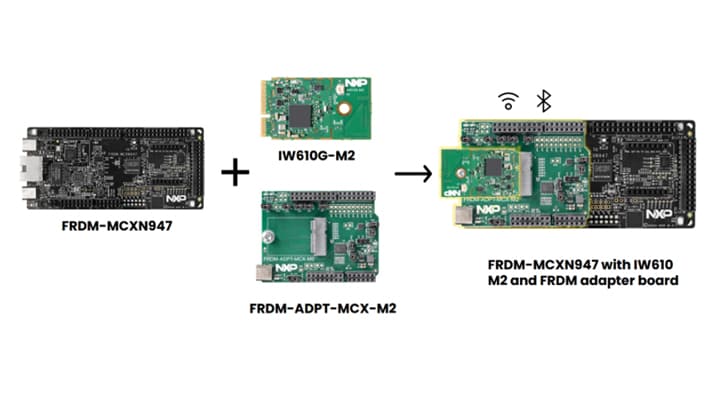 Designers can easily evaluate low-cost connected solutions using the IW610G-M2 with
the MCXN947.
The IW610G-M2 Development Card and FRDM-ADPT-MCX-M2 enables connectivity prototyping on the MCX platform, the
lowest-cost tier in NXP's processor portfolio. FRDM-MCXN947 is the first MCX board to gain Wi-Fi and Bluetooth
LE/802.15.4, and more will follow.
For higher-performance applications, the same card can also support platforms beyond the MCX family. Developers can
simply drop the IW610G-M2 into compatible i.MX application processors or i.MX
RT microcontrollers evaluation kits
equipped with an M.2 slot. Since one card serves the whole bench, prototyping is as simple as stacking two boards
and
importing an example project.
Applications That Benefit
Connectivity at MCU cost unlocks new applications in several important markets. With the IW610G-M2, developers can
expand wireless connectivity across a broader range of electronic products in key markets:
- Edge AI / Machine Learning: Anomaly detection, predictive maintenance, vibration analysis and
intelligent sensors
- Human-Machine Interfaces (HMI): Industrial operator interfaces and appliances
- Medical Equipment: Patient monitoring devices, portable diagnostic equipment and wearable
health devices
- Building Infrastructure: HVAC controllers, lighting control units, access control systems,
smart thermostats and occupancy sensors
- Industrial Automation: PLC modules, and industrial gateways
What's Next for Connected Design?
At NXP, we continue to refine our development ecosystem so that it enables designers to bring new products to market
faster. To help in this effort, the IW610G-M2 Development Card and the FRDM-ADPT-MCX-M2 adapter give engineers an
easier way to evaluate connectivity on NXP hardware. By offering a clear path from initial prototype to a shipping
design, our development resources help engineers build a smarter, more connected world.