The automotive industry is undergoing its most profound transformation in over a century. Software-defined vehicles (SDVs) are redefining how cars are architected, developed and experienced. This transformation demands a new class of compute platforms that are scalable, secure, and built for continuous evolution.
The NXP CoreRide platform is engineered to meet the challenge of the software-defined transformation of the automotive industry. It is a system-level solution that integrates compute, networking and power management and energy distribution with foundational software. The platform enables original equipment manufacturers (OEMs) and Tier 1s to accelerate development, reduce total cost of ownership and deliver differentiated, future-ready vehicles.
From Hardware-Centric to Software-Defined
Traditional vehicle architectures have evolved over many decades. Functions are tightly coupled to dedicated electronic control units (ECUs), each often developed by different suppliers. This results in numerous diverse hardware and software that is difficult to scale, update, or maintain. In contrast, SDVs decouple functionality from hardware, enabling features to be defined, deployed, and updated over-the-air (OTA) via software.
This shift to SDVs requires a compute architecture capable of managing everything from core vehicle functions —such as body, chassis, and lighting features— to advanced driver assistance systems (ADAS) and in-vehicle infotainment (IVI). The NXP CoreRide platform provides this foundation, combining high-performance processors, safety-certified software and deterministic networking to support real-time, mixed-criticality workloads across the vehicle.
By abstracting common foundations into a reusable platform, the NXP CoreRide platform enables automakers to move away from bespoke development cycles and toward a unified, scalable architecture that supports continuous innovation.
Build smarter, faster, and with confidence.
Learn how the NXP CoreRide Platform reduces complexity and accelerates your path to production.
Accelerating Development Through System-Level Integration
The NXP CoreRide platform is not a patchwork of components. It is a pre-integrated, pre-validated and optimized platform that enables parallel hardware and software development. By leveraging virtual models, engineering teams can begin system and software development before physical prototypes are available. This flexibly start compresses development timelines and reduces risk.
The platform integrates compute (S32N, S32K5), networking (S32J with time-sensitive [TSN] support), system power management and 48V / 12V hybrid energy distribution into a cohesive system, pre-validated and optimized with foundational software from trusted partners. This eliminates the need for OEMs to align disparate suppliers or resolve integration issues when build ECU foundations, allowing them to focus on innovation and differentiation.
The NXP CoreRide platform’s system-level approach also supports early safety analysis and architectural validation, enabling teams to meet functional safety goals (ASIL D) more efficiently and with greater confidence.
Safe Consolidation and Scalable Compute Architectures
As vehicles become more software-defined, the need to consolidate ECUs while maintaining safety and performance becomes critical. The NXP CoreRide platform supports safe consolidation through hardware-enforced isolation, fault containment and real-time communication protocols.
The NXP S32 processing platform is central to the NXP CoreRide platform. The S32 processing platform is designed to run mixed-criticality workloads in parallel, with strict separation between domains. This allows functions such as body control, lighting and chassis management to be consolidated onto a single ECU, reducing hardware complexity and wiring while maintaining safety integrity.
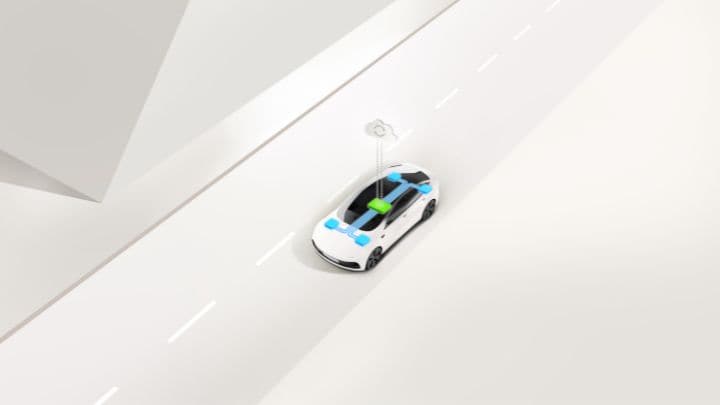 The NXP CoreRide platform enables scalable, future-ready architectures with unified hardware and software for next-generation vehicles.
The NXP CoreRide platform also supports both zonal and centralized compute architectures. Zonal architectures distribute compute closer to sensors and actuators, improving latency and modularity, while centralized architectures simplify software deployment and lifecycle management. The NXP CoreRide platform enables both, giving OEMs the flexibility to tailor their architecture based on vehicle class, performance requirements and brand strategy.
Reducing Total Cost of Ownership Through Reuse and OTA Updates
The NXP CoreRide platform’s modularity and standardization enable significant cost savings across the vehicle lifecycle. By reusing safety-certified software across multiple platforms and vehicle generations, OEMs can reduce validation effort, shorten certification cycles and lower R&D costs.
The platform also supports secure OTA updates, allowing automakers to deliver new features, performance enhancements and security patches post-sale. This extends the vehicle’s lifecycle, reduces the need for physical service interventions and aligns with consumer expectations for optimal digital experiences.
In addition, the NXP CoreRide platform’s architecture supports intelligent energy management, including smart battery control and power distribution—critical for electric vehicles where every watt of compute must be balanced against propulsion efficiency.
Built-In Safety and Cybersecurity for Mission-Critical Systems
Safety and security are foundational to the NXP CoreRide platform’s design. Its processors meet ASIL D requirements, making them suitable for mission-critical applications such as braking, steering and powertrain control. To preserve system integrity, hardware isolation ensures that faults or attacks in one domain do not propagate to others.
The NXP CoreRide platform’s networking components support Time-Sensitive Networking (TSN), enabling deterministic, real-time communication for safety-critical messages. This ensures that signals from crash sensors or braking systems are prioritized and delivered without delay.
Cybersecurity is embedded at every level of the platform. Secure boot, encrypted data streams and hardware-based firewalls protect against unauthorized access and tampering. These protections are essential in an era where vehicles are increasingly connected and exposed to external threats.
A Platform for Innovation, Collaboration, and Scale
The NXP CoreRide platform is a strategic driver for the automotive industry’s transition to software-defined mobility. By providing a stable, scalable foundation, the NXP CoreRide platform allows OEMs and Tier 1s to focus their engineering resources on differentiation, whether through advanced user experiences, AI-powered ADAS or intelligent energy optimization.
The platform also reflects a broader shift in the automotive value chain—from linear supply models to collaborative ecosystems. NXP is not just a silicon provider; it is a system-level partner bringing deep expertise in compute architecture, safety and integration. The NXP CoreRide platform is the result of this collaborative approach, designed to help automakers move faster, scale smarter and innovate with confidence.
Engineering the Future of Mobility
As SDVs become standard in the automotive industry, the ability to deliver safe, secure and continuously evolving vehicles will define market leadership. The NXP CoreRide platform provides the foundation for this future, enabling OEMs and Tier 1s to meet the demands of digital mobility with speed, precision and confidence. The NXP CoreRide platform offers a path forward—one that is scalable, secure and ready for the road ahead. As the industry continues to evolve, the NXP CoreRide platform will be essential, not just to be up to speed, but to lead.