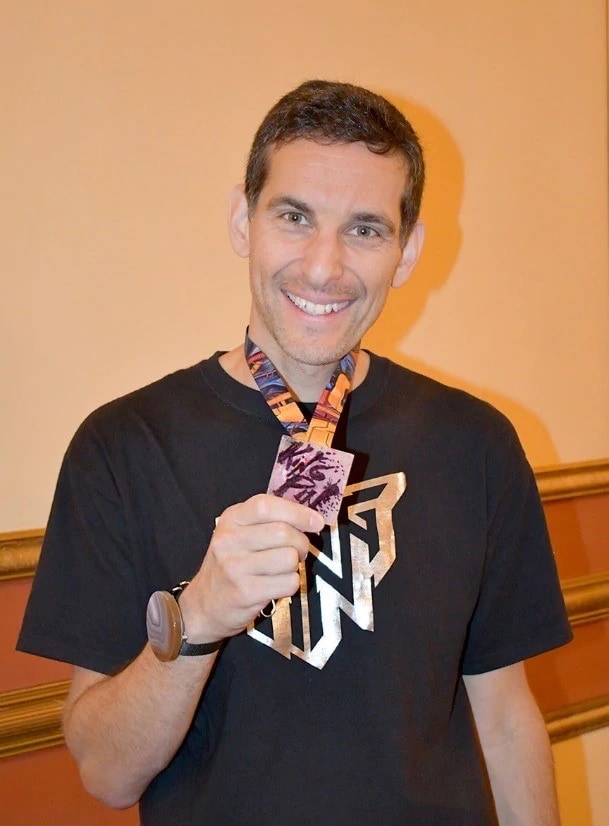
Joe Grand is an American computer engineer, product designer and hardware
hacker, known in the hacker community as Kingpin. He appeared on the Discovery
Channel television show Prototype This! and is the founder of
Grand Idea Studio . This year, he created
DEF CON
27’s official attendee badge with NXP’s
near-field magnetic induction (NFMI)
and the
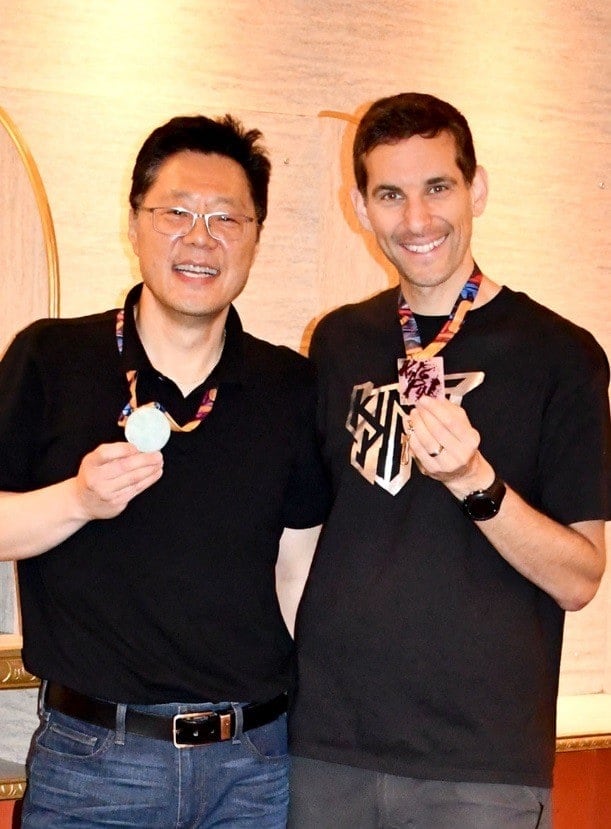
KL27 Arm® Cortex®-M0+ based MCU . Jae Park, Marketing and Communications Manager at NXP, met Joe at DEF CON
27, the world’s largest and oldest continuously running hacker
convention, in Las Vegas. Continue to read their interview to get insights
into Joe’s career and to learn what drove him back into creating the
badge again, after a self-imposed “badge retirement”.
Jae: Tell us about yourself—how did you get into hacking?
Joe: My older brother had been involved with computers. I always looked up to
what he was doing. When my brother became a teenager, he decided to become a
musician. He stopped using computers, so I inherited all of what he had set
up.
We had an Atari 400 computer, a modem… I was fascinated by this world
where you could connect to other computers and communicate with each other.
Something clicked in my brain and I was like “this is really
cool!” Around that same time, I started getting involved in electronics
because my brother had a junk bin full of old radio receivers and electronics
that weren’t working. We made a deal: I would clean his room or do
other errands for him and he would let me choose from the bin! This is when I
built up my hardware collection, started reading electronics magazines and
realized I could build my own things.
At the age of 13, I etched my first circuit board and I figured out how to
make free phone calls at an even younger age. I could connect to long distance
bulletin board systems and was impressed by the community of computer
enthusiasts. I just knew from that age that engineering was my passion and
I’ve been lucky to turn my passion into a career.
In 1992, I joined a hacker group called the L0pht in Boston (Joe was 16 years
old). It was one of the first publicly facing hacking groups. I learned a lot
from the other guys, who were at least six years older than me. They taught me
about sharing information, getting people inspired about the good that hackers
could do and exploring things in a legally safe environment. I found people I
could be with. They took me under their wing and kept me out of trouble. They
directed me in the right way!
Jae: You came out of “badge retirement” to create this
year’s
DEF CON
badge—what drove you to get back into the game?
Joe: I first designed the DEF CON badge for DEF CON
14 , which was 13 years ago—it was the first artistic electronic badge
for a conference. It was a simple embedded system in the shape of the DEF CON
logo with some blinking lights at eyes. We didn’t know how people would
react, but the response was overwhelming. I then designed DEF CON
15 ,
16 ,
17 ,
18
badges, all of which had different aesthetics and features. At that point, the
design resources and the tools became more accessible. The DEF CON community
was growing to the point where people were making their own
“unofficial” badges for electronic projects.
At this point, I figured my work was sort of done. DEF CON had gotten people
interested in hardware and #badgelife, as we call it today, had taken on a
life of its own. I stopped designing badges after DEF CON 18 because I wanted
DEF CON to see what other people would design. As hackers, we always want to
progress, try something new and learn something.
Nine years went by of various people doing various types of electronic and
sometimes non-electronic, badges. At the end of 2018, The Dark Tangent (aka
Jeff Moss, founder of Black Hat and DEF CON), who runs DEF CON, called me up
out of the blue. He asked: “Hey, do you want to do this year’s
badge?” The timing was just right because I was traveling a lot for
teaching my
classes on hardware hacking , but I wanted to stay home more. I thought doing another DEF CON badge would
be a good opportunity to spread my passion for engineering and get a larger
audience excited about interesting technologies.
Bright minds. Bright futures. NXP team members create breakthrough technologies that advance our world.
The future starts here.
This year’s DEF CON will welcome more than 28,000 attendees. This is a
whole new world of people getting involved in the community, helping and
learning from each other. I really liked this year’s theme:
technology’s promise. It’s not the dark, sort of ominous,
“big brother” theme it’s had in the past. Instead
it’s focusing on how technology can make our lives easier. This theme
really struck me, so I wanted to create something that would foster that.
Jae: Can you tell us more about the badge and what DEF CON attendees will
experience?
Joe: The main concept of the badge is a quest, where DEF CON attendees must
experience DEF CON and interact with other attendees. Attendees have to
complete different tasks: go to a talk, or a village, watch or participate in
a contest, go to a party and go to some arts or entertainment at the event.
There will be DEF CON Goons, volunteers working for the conference, in those
different areas that have special badges called magic tokens. The magic tokens
will change the state of the attendee’s badge to help them progress
through the quest. My starting point for creating the badge was: “What
if this was my first time at DEF CON?” I knew that with so many people
and so many things to do, you can’t do everything. We wanted attendees
to be able to experience DEF CON in their own way, doing what they like to do,
but still being able to have fun with the badge quest.
The badges communicate with each other using
NFMI (near field magnetic induction) , which is pretty cool and not something that most people have seen before.
The final state in the quest really highlights the qualities of
NFMI—being able to broadcast one to many or many to one. The NXP team
out of Belgium really helped with this complex portion of the design and it
wouldn’t have been possible without them.
All of the badge design documentation is up on
my website , to help people who want to dig deeper into the design and learn more about
the electronics, firmware or manufacturing process.
Jae: Why did you choose to work with NXP on this?
Joe: When I was in university, back in the late 90s, I had learned most of my
embedded system development on Motorola parts. Motorola spun off to become
Freescale, so I started using Freescale microcontrollers. Freescale was in
four of my five DEF CON badges. The first one was Microchip and then the next
four were Freescale. I just had a great team of people within the company,
supporting me, providing samples and coming to the show.
When Freescale became
NXP , it was a logical choice to continue working with NXP’s products. I
had a history with the company and even though the team had changed, I kept in
touch with my former colleague Dennis Hicks. I called him out of the blue and
said, “I’m doing DEF CON, what cool technologies can you
recommend?” Having that past relationship made it simple to choose NXP.
I knew that you had the volumes and capability to support our crazy adventure!
Jae: What’s in your kit that you’re bringing to DEF
CON?
Joe: I mostly brought badge hacking development tools. That way, if people ask
me what to use, I have some tools to recommend. I have an
LPC-Link2
which is used for loading new firmware onto the badge using the SWD interface.
That connects to a
Tag-Connect cable
to make it easier to connect onto the board. I also have a 1.8V-level UART
interface on the badge, which gives people an interactive menu that they can
do cool things with. Overall, I don’t bring too much with me, since I
like to collect new things at DEF CON.
Jae: Any tips for “noob” hackers—what advice would you
give?
Joe: I would say for somebody curious about hacking or getting involved in
hacking, it’s all about following what you love to do and then question
it! A lot of people feel like they should follow a certain path. But once you
find the thing you’re passionate about, then you can dive into it. I
don’t think that you can really teach somebody to be a hacker. But if
they have that seed, then they can find something within the community that
they like. Because at DEF CON, it’s not just technology. You have
biohacking, you have lockpicking, mechanical things. And then you have crazy
things like aircraft, automotive and voting. There’s this whole wide
range of options. Don’t just use technology because that’s what
you’re supposed to do, but question it and question why is that
technology being used and learn; you’ll learn from it.