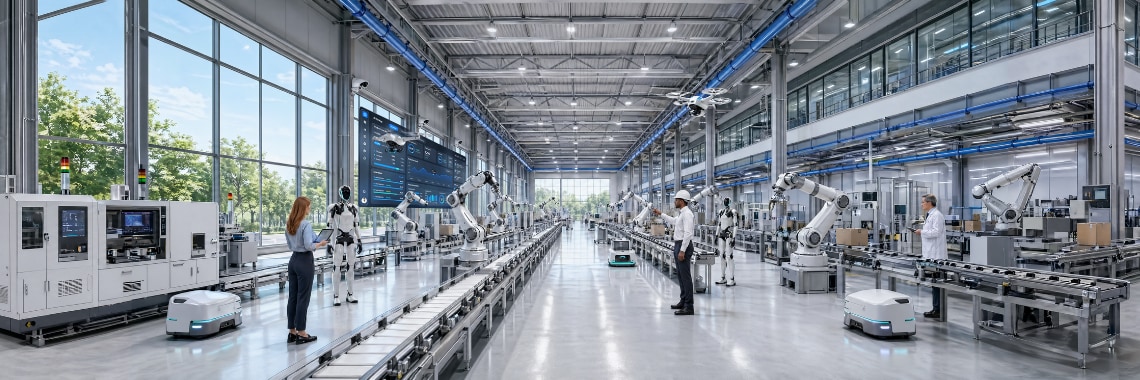
NXP and NVIDIA are working together to help make physical AI and robotics safer, more scalable and ready for
deployment
in the real world. As robots move into factories, hospitals and public spaces, safety becomes the condition for
scale.
These systems must sense, decide autonomously and act in real time while delivering consistent and safe behavior.
For years, AI has lived mostly in the digital world—analyzing data, generating insights and making recommendations.
But
as robots move into everyday settings, AI needs to do more than just think. It needs to sense, anticipate and act.
This
is physical AI, where intelligence is embedded into real-world devices.
This shift requires collaboration across the ecosystem. NXP is working with NVIDIA to develop common safety concepts
and
define a safe-by-design approach for robotics platforms. In
particular, NXP is part of a growing ecosystem of partners announcing NVIDIA Halos for Robotics – the
industry’s
first comprehensive functional safety system for robotics and physical AI.
NXP is a member of the
NVIDIA Halos AI Systems Inspection Lab, an ANAB-accredited program for physical AI functional safety,
helping partners prepare Halos integrations for third-party certification by leading certification bodies including
TÜV Rheinland, UL Solutions, TÜV SÜD, exida, SGS and CertX. The lab helps ensure that NXP safety processors
complement AI compute and meet the safety integration assumptions and requirements of the industrial-grade and
safety-first NVIDIA IGX Thor platform.
Why Safety Defines Scale for Physical AI
In physical environments, intelligence must operate in real time, under tight constraints of latency, power and
reliability. Systems must interpret complex surroundings, respond instantly and adapt to unpredictable conditions.
They
have to be accurate, but they also have to be dependable.
That is why safety is fundamental. If robots are to work alongside people, they must do so safely. Safety becomes the
foundation on which physical AI systems are built.
Delivering safety in controlled environments is one thing. Potential hazards can be assessed in advance, and robots
can
be programmed to avoid them. But when robots move freely around people, everything changes. Human behavior is
unpredictable, and risks must be assessed and mitigated in real time.
In these environments, robots have to be dependable. Every action must be predictable. Every interaction must be
trustworthy. Safety cannot be built in later. It must be designed in from the start.
What Does it Take to Make Robotics Safe in Public Spaces?
In this new reality, safety is a system-level challenge. It depends on four things:
Understanding the World
Safe behavior starts with awareness. Robots must be able to sense and interpret their surroundings and understand the
context. This means combining inside-out perception (how the robot experiences the world) with outside-in awareness
(how
it interacts with the world).
Independent Safety Monitoring
Incorporating independent safety monitoring into robots provides the oversight that ensures behavior stays within
safe
bounds and that any anomalies are caught early. This needs to be distributed across layers that can supervise and
stabilize each other to eliminate single points of failure and increase resilience.
Trusted Operation in Real-world Conditions
In the physical world, timing is everything. Robots need to make the right decisions and make them instantly. This
kind
of intelligence requires reflex-like responsiveness where sensing, processing and action happen in tight,
deterministic
loops with minimal latency and maximum reliability.
Inspection and Certification Readiness
Safety has to be demonstrated. That means robotics systems need to be designed and built to enable inspection,
validation and certification. These are essential steps in ensuring that systems behave as intended when under
stress or
failure conditions. A system that cannot be verified will be difficult to trust.
How NXP Brings Trust and Safety Foundations to Robotics
NXP offers a range of ready-to-deploy integrated solutions for robots and humanoid platforms that implement
NVIDIA Holoscan Sensor Bridge. These solutions represent a scalable and secure platform enabling
perception, motion and
autonomy at the edge.
They also draw on NXP’s long-standing expertise in safety and security for mission-critical systems. With more than a
decade of automotive security expertise, NXP provides proven building blocks that help car makers ensure the safety
and
security of future vehicles. This know-how also enables NXP to play a strategic role in defining safety requirements
and
solutions for robotics applications.
Functional safety is enabled by a combination of functionally safe components and safe IP enhanced with system-level
safety features. Built-in redundancy prevents a single failure from leading to dangerous behavior, while a
checker-doer
supervisory pattern separates action and monitoring so that safety does not depend on one component alone.
This approach is backed by proven scale and real-world deployment experience. NXP brings more than 13 years of
experience delivering functionally safety solutions, supported by more than 700 TÜV SÜD-certified safety
engineers for ISO 26262 and more than 170 TÜV SÜD-certified safety engineers for IEC 61508, with more than 100
safety-compliant hardware and 24 software components already in production. Together, these capabilities strengthen
NXP’s ability to help define and enable safety solutions for next-generation robotics platforms.
This expertise aligns with the NVIDIA Halos AI Systems Inspection Lab, which also supports partners preparing for TÜV
SÜD certification – reinforcing a shared commitment to verifiable, standards-aligned safety across the NXP and
NVIDIA collaboration.
To protect against potential cyberattacks, the platform offers scalable hardware security built on secure elements
and
the EdgeLock® Secure Enclave . These mechanisms can evolve over time to help maintain security as
cyberthreats
change.
For example, the platform supports
EdgeLock 2GO lifecycle updates, includes AI for security and is ready to
implement
post-quantum cryptography (PQC).
To streamline development of safe robotics systems, NXP offers support on functional safety, reliability and security
via the
SafeAssure® Program. Our robotics solutions are also aligned with relevant certification standards
including
SIL
2 and SIL 3 requirements, helping to demonstrate safety and build trust.
Building Trust to Scale Robotics
Scaling robotics depends on making systems that are capable and, above all, safe, trustworthy and ready for the real
world. In physical AI, trust isn’t earned over time. It comes from being able to predict outcomes even when things
go
wrong. Safety must be designed in from the start and demonstrated before deployment. Safety, security and validation
work together to make wider adoption possible.
Scaling robotics depends on making systems that are capable and, above all, safe, trustworthy and ready for the real
world. In physical AI, trust isn’t earned over time. It comes from being able to predict outcomes even when things
go
wrong. Safety must be designed in from the start and demonstrated before deployment. Safety, security and validation
work together to make wider adoption possible.
That is the foundation NXP is helping to build—enabling robotics systems that can move beyond controlled environments
and into broader real-world use with confidence.