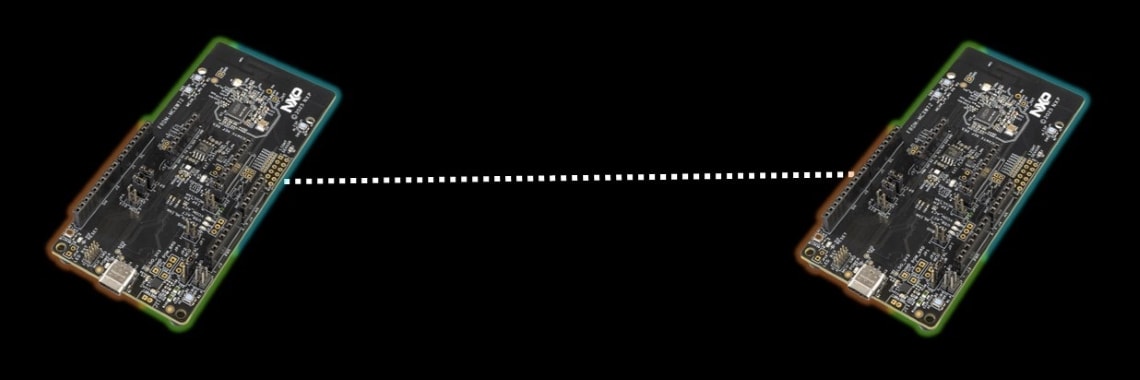
See the secure ranging Bluetooth® breakthrough in action. Bluetooth Channel Sounding (BCS) can be used for accurate, secure and low-latency distance measurements. To demonstrate how BCS works on the NXP FRDM-MCXW72 development board, our step-by-step videos will guide you through how to run demos on Visual Studio (VS) Code.
BCS is a Bluetooth 6.0 feature providing centimeter-level, real-time distance measurements between devices. It uses phase-based ranging (PBR) and round-trip time (RTT) to calculate distance, enhancing secure access for automotive and smart home applications.
NXP enables BCS on the MCX W72 multi-protocol wireless MCU, which supports Bluetooth Low Energy (LE) 6.0, Thread, Zigbee and Matter. It features a dedicated on-chip Localization Compute Engine (LCE) to reduce ranging latency and incorporate additional memory to support application-specific code, connectivity stacks and over-the-air (OTA) firmware updates.
The FRDM-MCXW72 development board—based on the MCX W72—is designed for flexible, rapid prototyping, offering easy evaluation of the MCX W72 features and capabilities. NXP's Application Code Hub (ACH) provides ready-to-use software examples that you can find at NXP’s MCUXpresso extension on VS Code.
This video shows a step-by-step guide on how to set up a real-time BCS demo on VS Code that measures distance between a FRDM-MCXW72 board and a smartphone.
This video shows a step-by-step guide on how to run a BCS demo on VS Code that measures distance between two FRDM-MCXW72 boards.
NXP’s ACH provides purpose-built software examples for the FRDM-MCXW72 and other development boards. Browse the ACH for software examples.