As AI enters the physical world, intelligence alone is no longer enough. Just as elite athletes rely on instinct and reflexes under pressure, physical AI systems must act safely, reliably and instantly in unpredictable environments.
In this blog, NXP President and CEO Rafael Sotomayor explains how reflexes, the Neural Axis Architecture and trust-by-design are creating a new blueprint for elite machine performance.
Over the past few weeks, billions have tuned in to watch some of the best athletes on the planet perform under extraordinary pressure. Every player in the world’s most-watched sporting competition has earned their place and possesses deep knowledge of the game.
So, what sets the elite apart? It’s not intelligence. It’s task mastery. The ability to act—instantly, precisely and reliably—without hesitation is what separates the truly elite athletes from the rest.
That same question now sits at the center of one of the most important technology shifts of our time: what does “elite performance” look like in machines moving among and beside us in the real world?
CEO Rafael Sotomayor shared NXP’s vision on bringing AI into the physical world at Computex 2026. Watch the keynote speech to learn more.
From Intelligence to Reflexes
Today’s AI systems are remarkable given that they can see, reason and generate insights at remarkable scale.
But when intelligence leaves the cloud and enters the physical world—into vehicles, robots and autonomous systems—the rules fundamentally change. The real world is a highly unpredictable place where Murphy’s Law and Finagle’s Law can come into play: if something can go wrong, it will go wrong and do so at the worst possible moment.
In the real world:
- Latency matters
- Energy matters
- Reliability matters most
Put simply, reality is that no system can think its way through every moment. Just like elite athletes, machines must develop something deeper than intelligence. They need the machine equivalent of instinct and reflexes.
"Reflexes—not language, not reasoning—are the hardest thing in robotics."
Rafael Sotomayor
Nature Already Solved This Problem
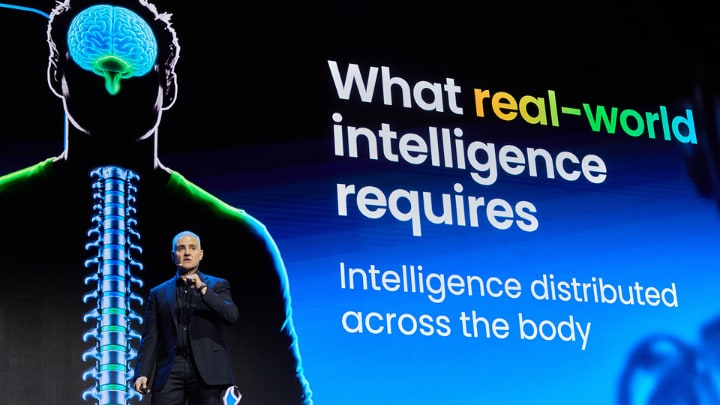
The most advanced physical AI system ever built is not located in a data center—it is found in the human body.
Human intelligence is not centralized. It is distributed across three critical layers:
- A reasoning layer for planning and learning
- A coordination layer for movement and balance
- A reflex layer that acts instantly, without waiting
When something hot is touched, there is no moment of deliberation—the reaction comes first. The body moves before the brain fully processes what has happened.
This functioning is not accidental. It is the result of billions of years of optimization, known in nature as evolution. It reveals a critical insight: Intelligence does not scale through making the brain bigger, but by placing the right intelligence in the right place.
NXP CEO Rafael Sotomayor sharing his vision for physical AI: "Stop thinking brain. Start thinking neural axis."
The Rise of the Neural Axis Architecture
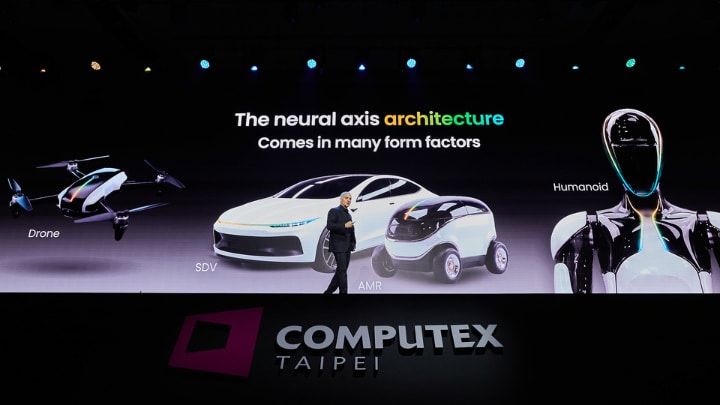
As physical AI systems evolve—from drones to software-defined vehicles (SDV) to humanoid robots—the same non-negotiable pattern is emerging. Intelligence is organizing itself into a distributed architecture—a neural axis. Its operational layers consist of:
- Reasoning at the top
- Coordination in the middle
- Reflexes at the edge
Each layer operates at its own speed, and each layer performs its specific function. This enables:
- A drone to safely stabilize itself in milliseconds when a sudden gust of wind hits it
- A vehicle to remain safe even when higher-level systems degrade, such as when connectivity is lost
- A robot to react instantly to unpredictable events, when a person unexpectedly steps into its workspace
Because in the physical world, waiting is failure.
The Neural Axis Architecture, NXP's architectural model for Physical AI
Trust Must Be Designed, Not Earned
A fundamental truth about physical AI is that trust cannot be earned over time. Assurance must be designed from the very first action, as these systems operate in environments where failure has real and tangible consequences.
Trust is not defined when everything works—it is defined in the most critical moments such as:
- When a drone loses a motor
- When a vehicle loses higher-level intelligence
- When a robot is unexpectedly disrupted
In those moments, systems must behave predictably, safely and reliably. This is non-negotiable.
Achieving this level of embedded trust requires a new design philosophy: NXP’s Trust Primitives which:
- Contain failures instantly
- Protect systems at every level
- Verify behavior through measurable safety frameworks
- Continuously adapt over time
Because in the real world, there is no undo button.
NXP CEO Rafael Sotomayor presenting the four Trust Primitives that enable trust in physical AI.
"We cannot design systems where nothing goes wrong. But we can design systems where, if something goes wrong, it still goes right."
Rafael Sotomayor
From Vision to Real-World Impact
Physical AI is no longer theoretical. Real-world impact is already visible:
- In factories: increasing efficiency while improving worker safety. AI-enabled robotic systems have been shown to deliver up to 40% higher operational efficiency than traditional automation in leading deployments. Source: AllAboutAI, 2025
- In healthcare: enabling new levels of precision and reliability. Demand for medical robotics is exploding: According to the World Robotics 2025 report, sales of diagnostics & medical laboratory robots jumped by an incredible 610%.
- In logistics: By 2028, 40% of smart robots used for asset inspection and monitoring will collaborate with drones, up from 5% in 2024. (Gartner Executive Briefing on Emerging Technology Smart Robots, Nov 2025)
However, this progress does not happen in isolation. It is driven by deep collaboration across ecosystems, industries and the global engineering community.
- Across industries: creating entirely new ways for humans and machines to collaborate.
Source AI in Robotics Statistics 2026: Adoption, Efficiency & Future Outlook .
Redefining “Elite” for Physical AI Systems
In the end, what defines an elite athlete is often what remains unseen: the reflex-like micro-adjustments, the invisible system enabling consistent performance under pressure—what we call the Neural Axis Architecture.
Physical AI follows the same principle. Elite is not defined by intelligence alone. Elite is defined by reliable, real-world performance—under real conditions—especially when things go wrong.
This will define the next generation of machines. It will also determine how—and how quickly—physical AI becomes part of everyday life.