Author
Monica Cid
Mónica Cid has worked in Mass Market Marketing for 3 years, focus on developer journey for industrial and consumer processors and microcontrollers. She is based in Guadalajara, Jalisco, Mexico.

We’re thrilled to announce the winners of the 2025 NXP Design Contest using NXP’s FRDM i.MX 93 Development Board! Developers and engineers from around the world demonstrated their exceptional creativity, innovation, and technical expertise, transforming the FRDM i.MX 93 platform into solutions that address real-world challenges.
The contest invited participants to “Design Beyond Boundaries” using NXP’s powerful edge computing platform. Numerous idea submissions were received before the July 15th deadline. From these submissions, a select few were chosen to receive FRDM i.MX 93 boards between July 16th and August 15th. These participants then had until October 15th to bring their visions to life, with winners announced on October 30th.
Order a FRDM i.MX development board for your next project.
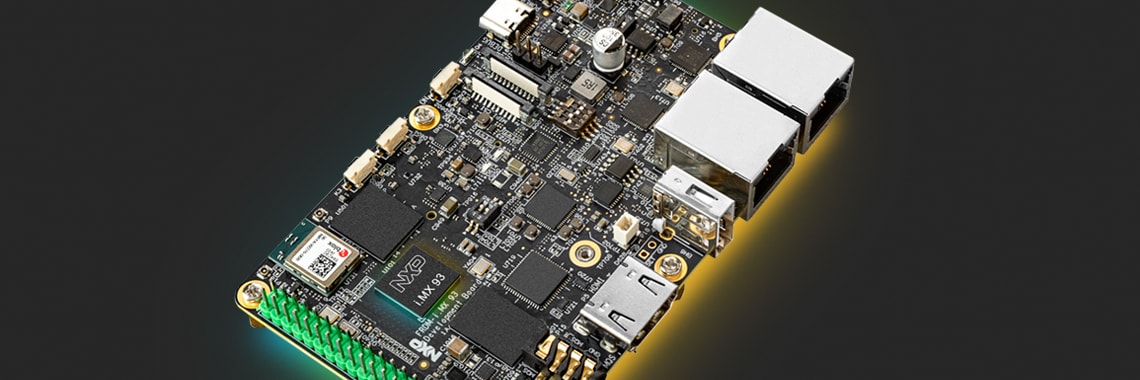
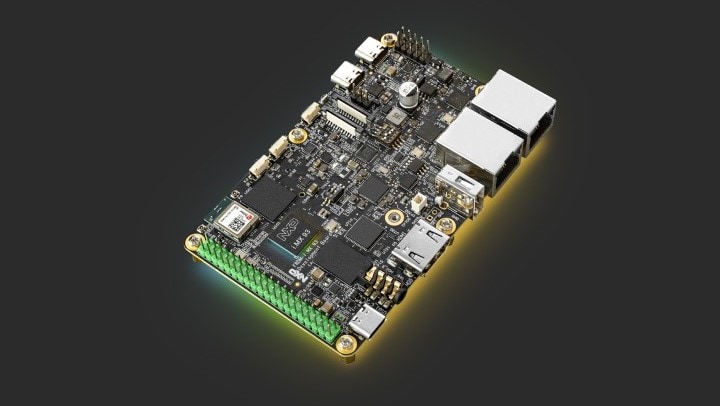
Built on NXP’s i.MX 93 applications processor, the FRDM i.MX 93 board is ideal for a wide range of edge computing applications. The board features a heterogeneous multicore architecture with an energy-efficient Arm Cortex-A55 core, a Cortex-M33 core, and an Arm Ethos-U65 microNPU for on-device AI processing.
In addition, the platform includes a 40-pin expansion header, and is equipped with an onboard IW612 module, featuring NXP's Tri-Radio solution with Wi-Fi 6 + Bluetooth 5.4 + 802.15.4 connector for Wi-Fi/Bluetooth add-ons , as well as an integrated SWD debugger . These features enable the FRDM i.MX 93 board to offer the performance and flexibility required for intelligent edge applications from industrial automation to smart home devices.
Pablo created a solar-powered environmental monitoring node that uses neural networks to detect illegal logging, poaching and potential wildfires. The system analyzes 3-second audio windows using a compact CNN trained on log-mel spectrograms, achieving approximately 94% accuracy in detecting chainsaw events.
The technical implementation is impressive. Pablo trained the model using TensorFlow/Keras on Google Colab's Tesla T4 GPU. Then, he exported the model as a TFLite INT8 quantized model and compiled it with Vela for the board's NPU. The real-time pipeline captures audio, extracts log-mel features, runs inference, and sends debounced alerts, all while operating on solar power with battery backup.
Looking ahead, Pablo envisions expanding the system to detect multiple threat signatures including vehicles, gunshots, and fire, while using low-power wireless connectivity to send privacy-preserving event alerts rather than raw audio streams.
Pietro developed an intelligent indoor climate control system that combines environmental sensing with embedded AI for automated air quality management.The system calculates an adaptive Air Quality Index from temperature, humidity, pressure and gas resistance readings.
The PyTorch-trained model was converted to TensorFlow Lite, quantized using NXP’s eIQ® Toolkit, and optimized to run at approximately 100 KB with less than 10 ms latency per inference on the i.MX 93’s NPU. The multi-head neural network architecture autonomously controls three systems: windows (open/close), VMC ventilation (off/low/high), and air conditioning (cool/off/heat).
Pietro created a Flask-based web dashboard that displays live sensor data, AI decisions, and 3-day weather forecasts. By integrating external weather data from WeatherAPI.com, the system compares indoor and outdoor conditions, all processed locally on-device for privacy and efficiency.
Mihai built a compact energy monitoring system for small-scale photovoltaic installations, tracking. This system uses the current and voltage sensors connected via the I²C LPI2C4 bus.
The system runs on the M33 core in bare metal style, with code written in C and compiled using ARMGCC . This setup reads sensors at 1 Hz, calculates battery state of charge, and generates smart alerts when consumption thresholds are reached (5A at 12V for the inverter, 3A at 5V for auxiliary output). The practical implementation monitors a 100W solar panel, MPPT charger, and 12V/55Ah battery setup.
Mihai’s future plan for the design includes adding an e-Ink display via SPI, creating MQTT integration with existing smart home systems, and expanding the solar array to make the monitoring system fully self-powered.
Congratulations to Pablo, Pietro, and Mihai for their outstanding work, and thank you to all participants who showcased the incredible possibilities of edge computing!
To learn more about the FRDM i.MX 93 platform and start your own project, visit NXP’s website. You can also explore the winning projects in detail: Pablo’s Forest Guardian , Pietro’s Smart Home System , and Mihai’s Solar Monitor.
Product Marketer at NXP Semiconductors
Mónica Cid has worked in Mass Market Marketing for 3 years, focus on developer journey for industrial and consumer processors and microcontrollers. She is based in Guadalajara, Jalisco, Mexico.