How do we give AI a moral consciousness – and
is this even possible? What kind of moral and social standards should be
established when creating autonomous machines? And who will set these
standards? The carmakers, the developers, the governments or the customers
themselves?
A self-driving car carries a young couple and their newborn home. An elderly
woman disregards the pedestrian light and steps suddenly into the road. What
will happen next? Will the car swerve to avoid the woman, crashing head on
into a tree? Or will the car continue on its programmed path, running over the
lady and saving the lives of its passengers? Both scenarios end with a
question that has no answer: Who should the car kill?
This “no win” scenario, dating back to 1950´s philosophy
known as the
“Trolley Problem,”
is just one of many that reveal the moral, ethical and social dilemmas
confronting us as we give rise to new technologies such as autonomous driving.
This scenario raises questions that demand urgent answers, as autonomous cars
are already on the move.
Smarter, greener, safer autonomous cars?
At the NXP FTF Connects Silicon Valley, these issues were discussed. Lars
Reger, Chief Technology Officer of NXP’s Automotive business
unit explained that these questions must be addressed collaboratively to
enable the obvious advantages of autonomous cars.
Autonomous cars could help prevent the nearly 1.3 million deaths in road
crashes each year, and could have a profoundly positive effect on the
environment. According to a research from the Department of Energy (DOE), electrified automated cars could reduce energy consumption as much as 90
percent.
All the advantages of these new vehicles could, in the worst case scenario,
never be realized, if one component is missing: trust. “There is no
market without the trust of our customers,” said Lars Reger. Trust is
key. And it must be established by all industry parties involved.
Moral values or personal interest?
The importance of the trust issue is also illustrated by
a newly-published study by MIT Media Lab. According to the scientists, most of the research participants refused the
idea of buying a vehicle with unpredictable behavior. Essentially, customers
want a car that protects its own passengers at all costs. This becomes a
social dilemma, as self-interest risks overpowering moral values; and a
technical dilemma too for the industry. How do they design algorithms that
reconcile moral values and personal interest?
These challenges are currently being tackled by the the IEEE AI Ethics
Initiative which developed Ethically Aligned Design, a go-to resource for
technologists to help them pragmatically address issues relating to AI and
autonomous systems in the algorithmic era.
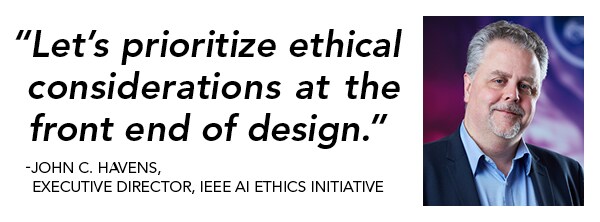
IEEE AI Ethics Initiative Executive Director John C. Havens pointed out that
while it may be impossible to plan for every imaginable ethical scenario with
self-driving cars, now is the time to establish key principles like
transparency and accountability for these systems to best innovate the
industry while prioritizing human wellbeing.
Ultimately, an autonomous car could be a trusted companion that is directed by
its owners’ personal data and values, said Havens. This is a perception
also shared by Lars Reger: “In the best case, an ethical autonomous car
helps you to avoid danger and enhances your capabilities.”
But who is to establish these rules and moral values? And how will our
personal data be used to shape the future of such technologies? The next 10 to
20 years will be a critical time in finding these answers. But one thing is
already clear: just like the engine, ethics will become a part of every car.
Monica Davis leads Automotive Marketing Communications at NXP Semiconductors. With a focus on software-defined vehicles and next-generation automotive platforms, she connects technology trends to the challenges and opportunities facing the mobility industry.