Traditional vehicle architectures are becoming a liability—as the pace of innovation accelerates across the industry, automakers risk falling behind without a rapid shift to a new vehicle core platform.
The automotive industry didn't arrive here overnight. It evolved step by step, with each new function layered onto the last, shaping architectures that reflect decades of incremental innovation.
For years, progress meant adding capability one ECU at a time — each with its own hardware, software and integration model. However, this approach worked when systems were relatively isolated.
But over time, it created something very different — fragmentation. Systems became harder to integrate, harder to update and increasingly difficult to scale. As outlined in a recent
Automotive News guest commentary , these fragmented architectures have become one of the core barriers to scaling software-defined vehicles.
Today, intelligence is moving deeper into the vehicle — not just into features, but also into the real-time functions that define how the vehicle moves, behave and operates. That's what we call the vehicle core - and it's at the center of this transition.
The Vehicle Core: Expected to Operate as One
The vehicle core: the safety-critical functions that make "a car" a car.
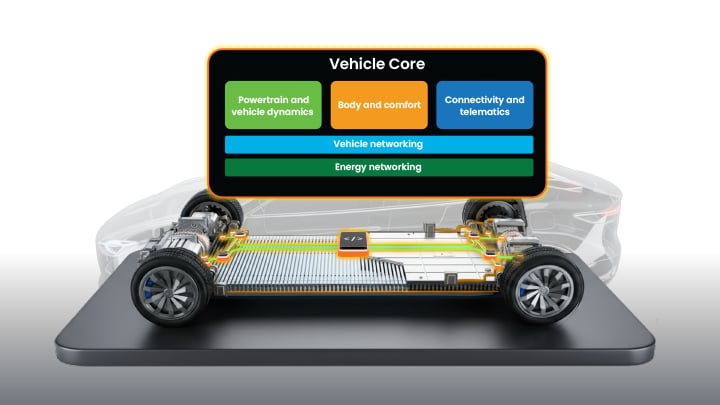
The vehicle core is a set of safety-critical functions — powertrain, vehicle dynamics, networking and energy management — that together define what the vehicle does, or what makes “a car” a car.
These functions operate across the vehicle — but what's new is the degree to which they must operate together as one coordinated system. That means that it is no longer enough to integrate function by function — the system as a whole must be synchronized, predictable and deterministic.
Why the Underlying Architecture Must Change
Software can no longer be tightly bound to individual hardware elements. As the foundation evolves, functions need to consolidate onto fewer, more capable compute platforms. This change also calls for the system to be structured so functions can operate together seamlessly instead of independently.
If this sounds familiar, there's a reason.
The data center industry went through a similar evolution and faced many of the same challenges first. In early data centers, applications ran on dedicated hardware — siloed, underutilized and difficult to scale. As demand grew, that model ultimately broke down under complexity and cost.
The first step forward came with virtualization. Workloads were no longer tied to a single machine, but could run across shared infrastructure. Utilization improved — but fragmentation persisted. As data volumes increased and systems became more distributed, complexity grew further — introducing fragmented tools, inconsistent environments and rising operational risk.
This shift, enabled by virtualization, marked the first step toward treating infrastructure as a unified, scalable system. But it wasn't enough on its own. Solving the problem required a broader architectural reset:
- Consolidation of compute onto shared platforms
- Standardization of software environments
- A networked backbone connecting the full system
- Orchestration replacing one-off integration
The result was a system that could scale — reliably and efficiently — as a cohesive whole.
Automotive is now entering a similar transition — but with the added requirement that synchronization and predictability are built in from the start. As intelligence moves deeper into the vehicle and system complexity increases, fragmented architectures begin to break down under integration effort, cost and inconsistency.
Managing that complexity requires designing the system to function as a coordinated whole from the start.
| Consolidated Compute |
√ |
√ |
| Aligned OS |
√ |
√ |
| Networking |
√ |
√ |
| Fit for Purpose |
√ |
√ |
| Scalable and Modular |
√ |
√ |
| Security |
√ |
√ |
| Remote Management |
√ |
√ |
The car as a data center on wheels.
You can think of the modern vehicle as a data center on wheels. But unlike data centers, vehicle systems are physical, safety-critical and time-constrained — which raises the bar for how tightly the system must operate together.
That's what's driving the shift to a new kind of vehicle architecture:
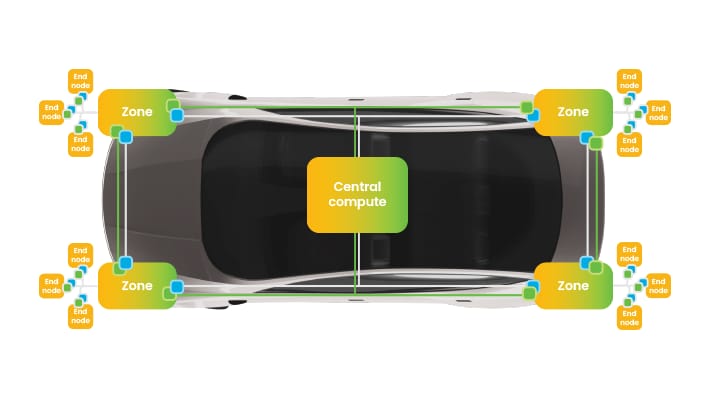
- Central and zonal compute working together
- A vehicle-wide data network that connects the system consistently
- An energy network that manages power across the platform
The next-generation vehicle begins with an architecture designed to work as one.
From Architecture to a Working System
If execution isn't controlled, you can design the system correctly — and still end up with inconsistent behavior. That's where middleware becomes essential. A deterministic middleware layer coordinates execution and timing across systems — ensuring predictable behavior. Without this, you still have parts. With it, you have a system.
A Shift Toward System-Level Foundations
The industry is moving away from building everything from scratch, program by program.
Instead, we see the emergence of system-level, pre-integrated foundations — architectures where compute, networking, energy management and middleware work together as a coherent baseline.
The goal isn't to limit flexibility, rather it is to remove friction through:
- Reduced repetition of integration work
- More predictable execution
- Faster path from development to deployment
Once the underlying system behaves consistently, everything above it can move faster.
Where the NXP CoreRide Platform Comes into Play
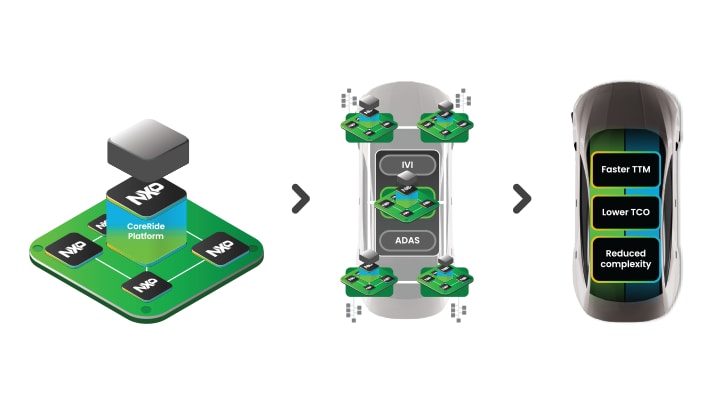
The CoreRide platform is a pre-integrated, system foundation that helps bring together key elements of the vehicle architecture, so automakers don't need to rebuild them for each program.
NXP CoreRide platform: clearing the path to the future SDVs.
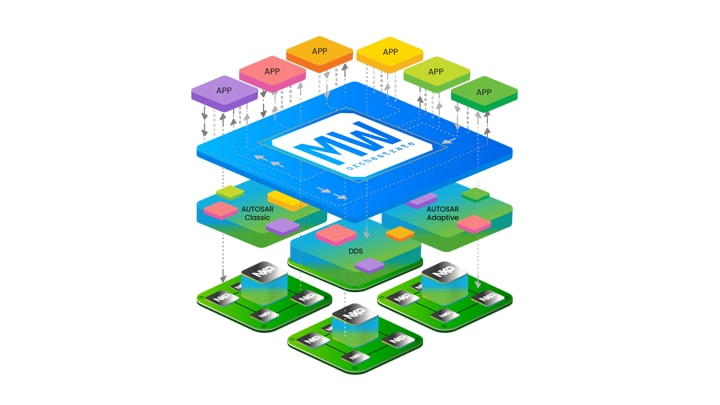
This platform provides a consistent baseline across compute, networking, power and energy management and system behavior, reducing integration efforts and enabling more predictable execution at scale. On top of that, middleware solutions such as
MotionWise provide the orchestration layer.
MotionWise ensures that distributed functions execute and communicate with synchronized timing and deterministic behavior — essential for coordinating safety-critical systems. Together with the CoreRide platform, they establish the foundation for the vehicle to function as one coordinated system.
CoreRide platform and MotionWise provide the foundation for vehicle-wide coordination.
The Foundation for Differentiation: Intelligent Platforms
Just as the data center evolved into a platform for running and scaling workloads, the vehicle is evolving into a platform for running and scaling intelligence.
The next wave of differentiation in the automotive industry lies in making the vehicle core itself intelligent — not just adding features around it, but embedding AI into how the vehicle operates at its core.
For example, an intelligent chassis system can detect road conditions such as potholes in real time and adjust suspension within milliseconds — improving comfort, safety and performance dynamically.
And this is only the beginning. As the vehicle core becomes intelligent and connected, entirely new use cases will emerge — many of which are not yet fully defined today. In practice, this changes where differentiation can come from.
How Differentiation Shifts in a Platform Architecture
In earlier architectures, differentiation came from individual features and ECUs. In a platform architecture, it comes from how effectively the system runs as a whole - and how intelligence is applied across the system.
AI depends on consistency — in data, in execution and in system behavior. Fragmented architectures struggle to provide that. A consistent, deterministic vehicle core makes it possible. That is what allows intelligence to move beyond isolated features and begin shaping how the vehicle operates as a whole — in real time and across fleets.
When the vehicle core operates consistently across the vehicle, automakers can build intelligent platforms on top - systems that continuously improve performance, adapt behavior and enable new capabilities over time. This shifts AI from an isolated feature to a foundational capability of the platform, and that platform becomes a key source of differentiation.
From Architecture to Outcome
Customers don't ask for software-defined vehicles. They expect vehicles that improve year after year — in performance, safety, efficiency and personalization. Meeting that expectation requires more than adding new features. It depends on a foundation that can support continuous, reliable change — a system foundation that allows intelligence and differentiation to scale.
With the right foundation in place, intelligence becomes part of how the vehicle works — not just something layered on top, but built into its core platform. This is what turns a software-defined vehicle into an AI-defined one.