AI continues to evolve rapidly, but one particular trend is gaining traction—intelligence is moving closer to where the actual data is created. Across robotics, industrial automation, smart infrastructure and autonomous systems, AI is evolving from perception to generation and action. Systems increasingly need to interpret information, make decisions and respond in real time, without relying on data to make a round trip to the cloud.
As AI moves into the physical world, developers need platforms that can scale intelligence while balancing power, memory, security and system complexity.
Accelerate trusted physical AI at the edge with scalable hardware, software and ecosystem support built for real-world systems. Hear Ravi Annavajjala explore the latest trends, challenges and future of AI accelerated at the edge on NXP’s EdgeVerse Techcast podcast (available on Youtube , Spotify or Apple ).
Moving Beyond "AI at the Edge"
As AI adoption accelerates, AI at the Edge has become a common industry focus. Nearly every platform today claims some level of AI inference capability. But for embedded developers, the challenge is often not adding AI, it’s deploying AI successfully within existing power budgets, security requirements and embedded architectures.
As teams work to add intelligence into existing embedded systems without increasing power consumption, this introduces integration complexity or encounters new security and safety concerns. Increasingly, developers need to balance multiple factors at once, including:
- AI performance
- Power efficiency
- Embedded integration
- Hardware architectures
- Memory requirements
- Security
- Ease of development
- Long-term scalability
Successful AI deployment depends on delivering intelligence while preserving the characteristics that matter most in embedded systems: predictable behavior, manageable power budgets and streamlined development workflows.
Why AI Workloads Are Changing the Edge
AI is evolving beyond isolated perception tasks toward entire systems that can interpret context, make decisions and act in real time. Voice, vision, sensors and control systems are increasingly working together dynamically to enable intelligent and autonomous behavior at the edge.
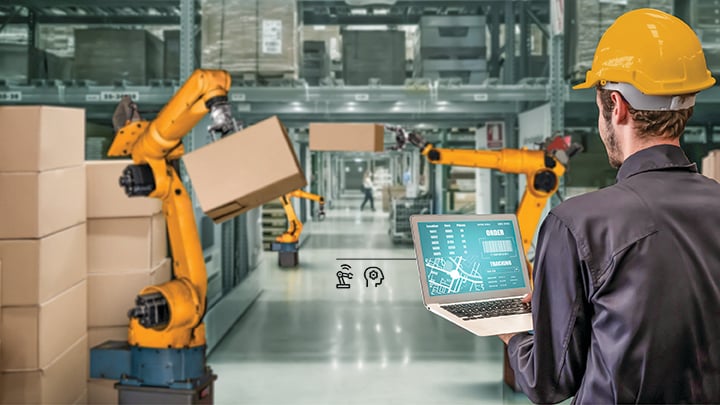
Consider a mobile robot navigating an industrial warehouse environment. It may need to:
- Interpret multiple camera feeds
- Detect and classify objects
- Fuse sensor information
- Understand environmental context
- Make navigation decisions in real time
- Maintain communication with surrounding systems
These tasks are significant because they often need to run concurrently and in real time, placing pressure on processing, memory and power resources at the edge. While application processors continue advancing, demands for low-latency AI inferencing often grow even faster. The challenge becomes finding a way to increase AI capability without requiring an entirely new system architecture.
Edge AI is transforming physical spaces and, with that, creating challenges for embedded developers.
Scaling Intelligence Without Increasing Complexity
Dedicated AI acceleration introduces a different model for system design. Rather than asking a primary processor to handle every task, developers need a system architecture that can support not only neural network inference, but also complete end-to-end AI workloads that connect business logic and physical access and/or control gateways. This requires specialized AI acceleration hardware that can run advanced workloads while allowing the host processor to continue managing system-level responsibilities.
The design of NXP's Ara240 Discrete Neural Processing Unit (DNPU) forms around this principle. As a dedicated AI companion processor, Ara240 enables developers to scale AI performance independently from the rest of the system architecture.
Advanced AI workloads, including computer vision, multimodal transformer-based models such as vision language models (VLMs), and large language models (LLMs), can be offloaded to the DNPU while the host processor continues managing connectivity, security, user interfaces and real-time control. This approach helps customers introduce more sophisticated AI capabilities without redesigning their entire platform. This architectural separation enables:
- Real-time responsive system performance
- Optimized power efficiency
- Local processing for enhanced privacy and reduced bandwidth requirements
- Security through workload isolation
- Scalable AI performance as workloads evolve
- Flexible memory scalability
Processing AI locally can also reduce dependence on cloud resources while constantly keeping sensitive data on-device. Combined with NXP applications processors, Ara240 helps developers build more flexible and future-ready edge AI systems that can evolve alongside changing AI models and workloads.
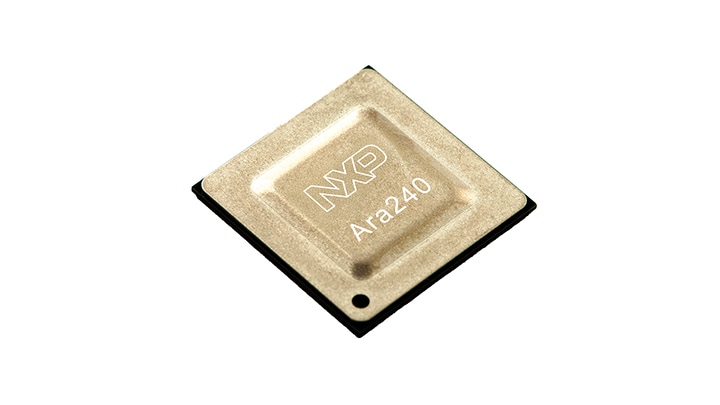
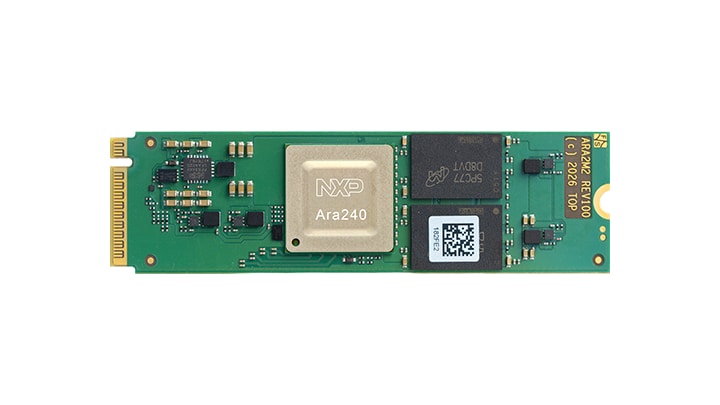
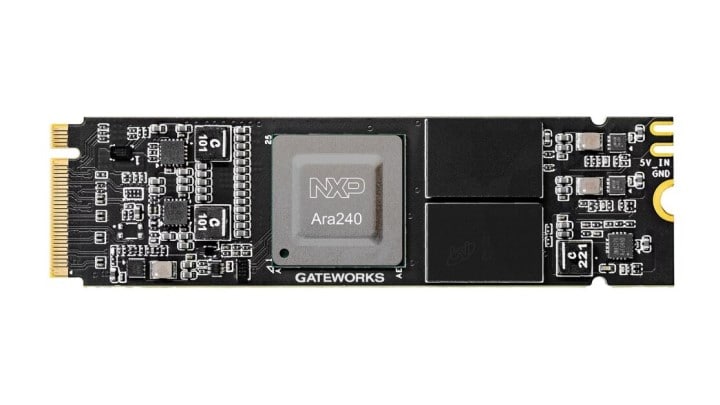
The Ara240 Discrete Neural Processing Unit.
Making AI Practical with the eIQ® AI Software Development Environment
Hardware acceleration is only one part of the solution. Developers also need software tools that simplify model development, optimization and support reliable deployment across a range of processing environments. The NXP eIQ® AI software development environment, helps developers move from experimentation to production by providing tools for model optimization, deployment and performance tuning across NXP microcontrollers (MCUs), microprocessors (MPUs) and AI accelerators.
Support for common AI frameworks and scalable deployment workflows helps reduce integration complexity while enabling developers to reuse AI investments across multiple product generations. Combined with NXP hardware platforms and ecosystem partners, eIQ helps accelerate the path from proof of concept (POC) to production-ready systems.
The Ara software development kit (SDK)—which will be part of the eIQ AI software—allows developers to compile models for benchmarking or deployment and run existing model binaries optimized for Ara240 in the Ara240 model zoo on Hugging Face.
Bridging Technology and Deployment
Powerful silicon alone does not solve today’s AI development challenges. Teams building embedded systems still need development platforms, software support, system integration guidance and long-term product strategies (life cycle support). This is where ecosystem collaboration plays an important role.
System providers such as F&S and Gateworks— along with other ecosystem partners—help translate processing technologies into deployment-ready platforms that reduce complexity early in the design cycle. Rather than starting from a blank hardware design, developers can begin with solutions that already incorporate memory layouts, power management, thermal considerations, software support and life cycle planning.
Accelerating Robotics and Functional Safety with F&S
As AI workloads continue expanding, many developers are facing a familiar challenge: bringing together multiple requirements that historically lived in separate realms. Modern systems increasingly need to combine Linux environments, AI frameworks, compilers, real-time responsiveness and functional safety architectures in a single platform.
This is especially visible in robotics and intelligent autonomous systems, where developers may need to manage multiple camera streams, run AI inference, support frameworks such as Robot Operating System 2 (ROS 2) and maintain safety-oriented operation simultaneously.
An Integrated Platform Approach
F&S addresses this challenge through integrated embedded platforms that combine hardware, software and long-term support into a complete development approach. Rather than simply delivering modules, support extends across the entire project life cycle, including hardware customization, Linux Board Support Package (BSP) support, thermal design considerations, security integration and life cycle management.
One example combines our i.MX 95 applications processors with the Ara240 DNPU to create a scalable platform for robotics, machine vision, autonomous systems and safety-oriented applications. In this architecture, the i.MX 95 manages system-level responsibilities, such as connectivity, security and control functions, while Ara240 provides dedicated AI acceleration for advanced neural network workloads.
For developers, this creates an opportunity to build systems that successfully combine AI, real-time responsiveness and functional safety without sacrificing familiar Linux and ROS-based development environments. As autonomous systems become more capable, balancing intelligence, control and trust becomes increasingly important.
Hear Andreas "Andy" Kopitz of F&S Elektroniksystem explore how developers can start building edge AI products using NXP's Ara 240 alongside the i.MX 95 system on chip (SoC), especially for robotics and autonomous systems on the Edgeverse Techcast (available on YouTube , Spotify and Apple ).
Bringing Industrial AI into Deployable Systems with Gateworks
For many embedded developers, the challenge is not simply adding AI capability; it’s reducing the complexity of bringing AI-enabled systems into production. Gateworks supports NXP’s edge AI and robotics strategy by helping bring scalable AI platforms into real-world deployments. Building industrial hardware from the ground up can require significant effort around power management, thermal design, memory configuration, software integration and long-term maintenance. These challenges become even more pronounced as AI workloads evolve from traditional computer vision to multimodal and generative AI applications.
Deployment-Ready Platforms for Edge AI
Gateworks helps simplify this process through industrial-grade single-board computers, AI acceleration modules and development kits built around NXP technologies. One example is the GW11062-1 development kit, which combines the NXP i.MX 95 applications processor with the Gateworks GW16168 AI accelerator powered by the NXP Ara240 DNPU. This integrated platform provides developers with a ready-to-use environment for evaluating and deploying advanced edge AI applications, helping reduce development effort and accelerate time to market dramatically, especially for frontier AI model support.
The combination of the i.MX 95 and Ara240 enables a scalable architecture in which system functions such as connectivity, security, user interfaces and control remain on the host processor, while AI inference workloads are offloaded to dedicated acceleration hardware. This approach allows developers to increase AI capability without redesigning the entire system architecture.
By providing deployment-ready hardware and software, Gateworks helps developers move more quickly from POC to production across applications such as autonomous mobile robots, industrial automation, smart energy systems and intelligent infrastructure.
Listen to Hailey Terrones explore the future of accelerated AI with Gateworks’ as she discusses how industrial AI is moving beyond cloud demos into real-world, mission-critical edge systems on the EdgeVerse Techcast (YouTube , Spotify or Apple ).
Looking Ahead
AI at the edge is moving beyond POC demonstrations into real-world systems.
Developers are being asked to build products that can see, hear, sense, understand and decide within tight response windows while balancing security, safety, performance and power constraints.
Meeting those expectations requires more than additional compute resources. It requires architectures designed to scale and ecosystems that help developers move from ideas to deployable systems.
The industry is moving from simply adding AI capabilities to enabling systems that can perceive, reason and act in the physical world. Success will depend on balancing intelligence with the realities of embedded design, including power, memory, security, safety and overall system complexity.
The future of edge AI will not be defined solely by model size or benchmark performance. It will be defined by how efficiently intelligence can be deployed into secure, scalable and power-conscious systems that solve real-world problems and accelerate time to market.