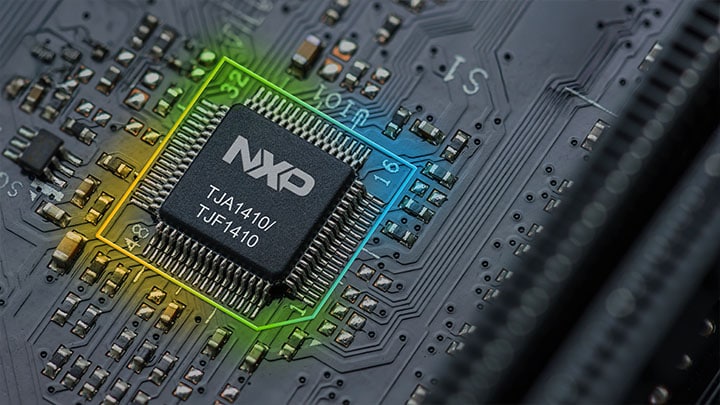
The PMD transceivers TJA1410 for automotive and TJF1410 for industrial enable OEMs to deploy low‑cost, multi‑drop Ethernet all the way to the network edge, critical for scalable software‑defined vehicle (SDV) and industrial architectures.
NXP Semiconductors today announced the industry-first, production‑released 10BASE‑T1S Physical Medium Dependent (PMD) transceivers, the TJA1410 for automotive and TJF1410 for industrial and building automation. These devices represent a big leap in Ethernet networking, enabling OEMs to extend Ethernet all the way to the network edge, providing a unified and scalable networking foundation to accelerate the transition to software-defined architectures. They offer a robust Ethernet data path with simplicity similar to that of CAN (CAN-like) and dramatically reduced system cost for scalable deployment. The TJA1410 is fully qualified for automotive functional safety relevant applications, while both devices support the latest Open Alliance TC14 specifications and robust EMC performance.
The PMD transceiver divides a traditional Ethernet PHY into two parts, allowing the digital portion to be integrated into the host MCU or switch, while the PMD handles the essential analog functions for transmitting and receiving signals on the physical medium. This approach allows low system costs and CAN-like simplicity for 10MB Ethernet deployments.
As automotive and industrial systems shift toward software-defined architectures, OEMs need a simple, cost-effective way to bring Ethernet to the network edge. The TJA1410 and TJF1410 speed up this transition by providing a reliable, small footprint, low pin count CAN‑like experience for Ethernet deployment. With 10BASE-T1S at the edge, OEMs can easily implement advanced capabilities such as AI-enabled sensor fusion and over-the the air updates in next-generation software-defined vehicles. They benefit from a multi‑drop, low‑cost Single Pair Ethernet (SPE) solution that reduces cabling, eliminates gateways, and unifies edge devices under a common Ethernet backbone.
In automotive, the new device allows to scale Ethernet into body, comfort, and zonal architectures while maintaining functional safety requirements. In industrial and building automation, it enables the migration from legacy field buses to secure, scalable, end‑to‑end Ethernet networks.
“10BASE‑T1S is a foundational technology that finally makes Ethernet viable all the way to the end-node – in automotive, industrial, and building systems. With our new PMD transceivers, we remove cost and complexity barriers and give our partners a scalable path to extend Ethernet all the way to the edge of their networks. With this launch, we set a new benchmark for cost‑effective and safety‑capable Ethernet connectivity in next‑generation software‑defined architectures. ”
Ritesh Saraf, VP and GM Ethernet, NXP Semiconductors
The TJA1410 is designed for automotive applications requiring functional safety support and offers ISO 26262 ASIL B compliance, robust EMC performance, low quiescent current, and support for remote wake (OA TC10/TC14) for enhanced power efficiency. The device can operate with lower cost CAN FD common mode chokes, reducing overall system costs for 10BASE-T1S networking.
Together with NXP’s automotive MCUs and switches that integrate MACsec‑secured 10BASE‑T1S ports, including NXP's S32K5, S32N7, and S32J100 families, the new PMD transceivers form a comprehensive system solution supporting end‑to‑end secured Ethernet communication. This enables OEMs to deploy scalable zonal and central compute architectures with built‑in security and high reliability.
For industrial and building automation applications, the TJF1410 brings the same disruptive PMD capabilities, enabling the replacement of legacy field buses such as modbus or RS-485 with multi-drop Ethernet. It unlocks the benefits of unified networking, higher scalability, and secure system-wide communication. The device also supports demanding industrial applications, such as building circuit breakers, far exceeding the node-count and cable-length guidelines in the automotive Open Alliance TC14 standard for PMD transceivers.
When combined with NXP’s MCX A microcontroller series, the TJF1410 delivers a comprehensive 10BASE-T1S system solution for industrial and building automation applications, optimizing system cost. Upcoming members of the MCX A series will incorporate 10BASE‑T1S ports, combining with TJF1410 to simplify system complexity and reduce bill of material (BOM) cost.
The transceivers are released for production demand and available now. Initial customer programs are already underway, integrating the devices into upcoming architectures. For more information, please visit nxp.com/TJA1410 and nxp.com/TJF1410.
NXP Semiconductors N.V. (NASDAQ: NXPI) is the trusted partner for innovative solutions in the automotive, industrial & IoT, mobile, and communications infrastructure markets. NXP's "Brighter Together" approach combines leading-edge technology with pioneering people to develop system solutions that make the connected world better, safer, and more secure. The company has operations in more than 30 countries and posted revenue of $12.27 billion in 2025. Find out more at www.nxp.com.
NXP and the NXP logo are trademarks of NXP B.V. All other product or service names are the property of their respective owners. All rights reserved. © 2026 NXP B.V
View this News Brief in German